Cebu Normal University
THE OFFICE FOR INTERNATIONALIZATION & GLOBAL CITIZENSHIP

CNU accomplishes FIRe 2019

In commemoration of the pursuit to advanced knowledge generation through research, Cebu Normal University (CNU) hosted the CNU FIRe (Festival on Innovations in Research) 2019 last October 17-19.

The three-day festival opened with the theme, “Complexity and Adaptation in the Era of the Fourth Industrial Revolution,” which focused on how research drove the emergence of the said revolution.

Dr. Floriza N. Laplap, Presidential Assistant for Planning and Development, delivered the words of welcome of Dr. Filomena T. Dayagbil, University President, highlighting the commitment of the academe to quality and relevant higher education through innovations.

“This gathering of intellectuals and innovators is a testament to our collective belief that research is the driver of innovation and one of the important keys in building a better future for our country,” Laplap said.

Rationale

Dr. Angeline M. Pogoy, Vice President for Research, Extension, and Publication, officially opened the exhibition booths at the Samuel MacClintock (SM) Hall and performances from the CNU Chorale and CNU Kudyapi Folkloric Ensemble followed.

The keynote speaker, Dr. Roberto N. Padua, Former Commissioner of Commission on Higher Education (CHED) Philippines, centralized his speech on social physics.

Meanwhile, plenary speakers Dr. Jonel P. Saludes, Associate Vice President for University of San Agustin, Iloilo, Philippines and Dr. Jan Chung-yuang, Minister, Examination Yuan, Republic of China, stated that the fourth industrial revolution is technology with conscience and a connection between education, human resources management, and government policies.

 In partnership with Philippine Society for Public Administration (PSPA), Dr. Jose Chiu-C. Chen, president of Taiwan Association for Schools of Public Administration and Affairs, spoke in front of the delegates during its second day.

CNU FIRe in partnership with Philippine Society for Public Administration (PSPA) continued on its second day at Tandang Sora Hall. 

The speakers were Dr. Jose Chiu-C. Chen, president of Taiwan Association for Schools of Public Administration and Affairs; Dr. Lizan Perante-Calina, president of Philippine Society for Public Administration; and, Dr. Alex Brillantes, president of Asian Association of Public Administration and Mr. Rene Sanapo of the Foundation for Economic Freedom, who shared experiences on their respective fields.

Muhammad Rais Prasetyo from Indonesia presents his study entitled “Improve Mental Health Status by Practicing Arabic Calligraphy” under the Health Promotions and Innovations strand.

The event was graced by delegates from different countries such as Indonesia and Taiwan; and the attendees, a mixed crowd of CNU faculty and Public Administration students. 

“CNU FIRe is really helpful para sa students of Public Admnistration… Naay mga techniques and other services [discussed in the forum] nga makapa-improve sa system sa Philippines,” said Paul Kevin Pocong (Bachelor of Arts in Public Administration II). He pointed out policy making, public governance, and e-government as vital topics related to his degree program.

During the event, speakers discussed about the purpose of Industry 4.0 and how it affects different sectors, as well as responses in government reform, and entrepreneurial development.

Presenting of researches

Research Presentor defends their study from the questions  of one of the research panel Dr. Daisy Palompon at Tandang Sora Hall.

Researchers from different state universities and colleges gathered to present their researches that were categorized into five strands during the afternoon session. 

The strands were Productive Pedagogy, presented at SM Hall; Health Promotion and Innovations, which took place at Eva Macapagal Memorial Arts (EMMA) Center; Complex Adaptive System at Tandang Sora Hall; Ecology, Biodiversity, Climate Change, and Modelling at the E-Classroom College of Nursing (CN) Building; and Culture, Arts, and Governance at CN Amphitheatre.

Infographics and Infomercial presentations preceded on the final day of the three-day event, followed by the endnote session with Dr. Rozzano C. Locsin, Professor Emeritus of Florida Atlantic University. 

In regards to CNU FIRe, Dr. Angeline M. Pogoy, Vice President for Research, Extension, and Publications, said that “taking the lead when it comes to the advancement of technology” is a must to become a leading, multidisciplinary research university.

Though the preparation of CNU FIRe had less than six months, she shared her most sincere gratitude to the strong manpower of the faculty and to the participants from the other nation and colleges that made the event successful. 

According to Pogoy, CNU FIRE may be the first of its name but research conferences have been organized and held by CNU every year for several years now. 

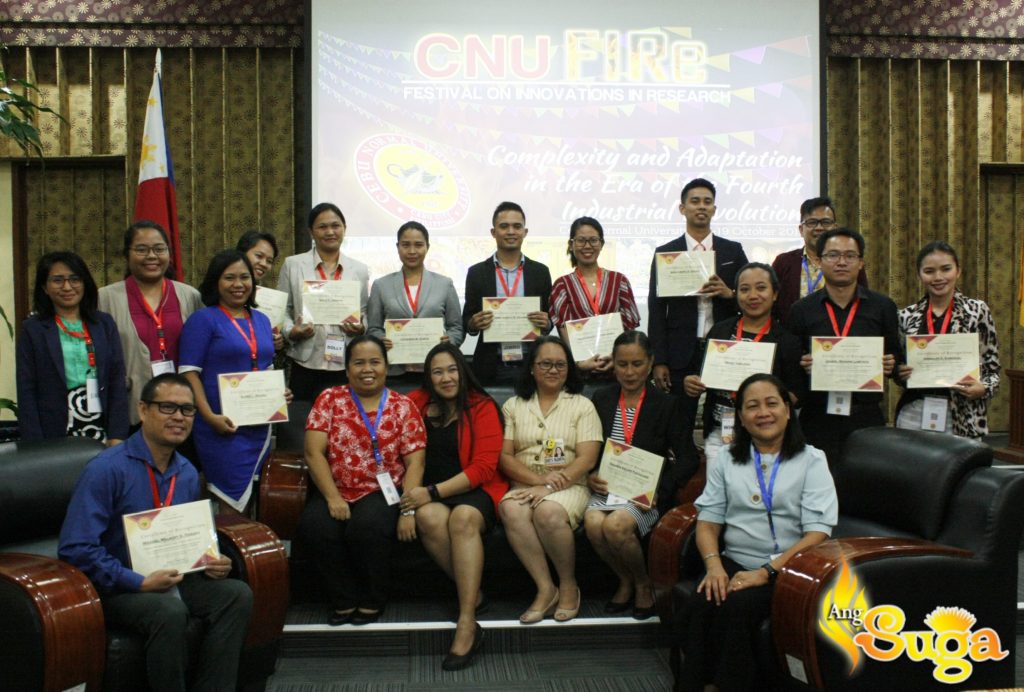
CNU FIRe concluded with an awarding ceremony of the best presenters and special awards for the following strands:

BEST PRESENTERS

Health Promotion and Innovations

1st Place – Effect of Safety Checklist in Addressing Nurse Handoff Communication Divergence

Presented by:  Mark Vincent P. Sarigumba

Authors: Mark Vincent P. Sarigumba, Symebelle G. Aguiman, and Rocky M. Camaligan

2nd Place – A Validation of a Non-linear Relationship on the Predictors of Violence Against Women (VAW) by Symbolic Regression

Presented by: Ernyl Henry Redula

Authors: Ernyl Henry Redula and Lovelyn G. Tipon

3rd Place – The Effect of Mirror Therapy Toward the Upper Extremity Grip Strength of Non-Hemorrhagic Stroke Patient in Dr. Moewardi Hospital

Presented by: Isnaini Rahmawati

Authors: Isnaini Rahmawati, Gatot Suparmanto, and Axel Aseta Winona

Culture, Arts, and Governance

1st Place – Community Extension Services of Cebu Normal University 

Presented by: Carlou John S. Letigio

Author: Carlou John S. Letigio

2nd Place – Contested Waters: Review of Literature on Water Contestations

Presented by: Ryan Dave Rayla

Author: Ryan Dave Rayla

3rd Place – Disaster Reduction and Emergency Assistance of Medellin (DREAM) Three-Component Framework: An LGU Resilience Modeling

Presented by: Jay Jumar R. Bacunawa

Author: Jay Jumar R. Bacunawa

                  – Social Progress Component and Indicators: Principal Component Analysis

Presented by: Rodin Paspasan

Author: Rodin Paspasan

Productive Pedagogy

1st Place – A Dose-Response Model for Advanced Education and Skill Sets in Enhancing the Probability of Employment

Presented by: Nigel Glenn N. Javier

Authors: Nigel Glenn N. Javier and Angeline M. Pogoy

2nd Place – Flipped Classroom Technique for Enhancing Grammatical Competence

Presented by: Maricel D. Rivera

Authors:  Maricel D. Rivera and Grace M. Flores

3rd Place – 4C’s in Teaching English to Senior High School

Presented by: Donna Grace I. Cotejo

Authors: Donna Grace I. Cotejo, Geraldine Amado, Julie Cabalquinto, and Michelle Landao

Complex Adaptive System

1st Place – Characterization of Mining Behavior of Selected Metals in the Philippines through a Bass Diffusion Model

Presented by: Jhudiel Masong Lobitaña 

Author: Jhudiel Masong Lobitaña

2nd Place – Capacitating Research Faculty for University-hood Using Bass Diffusion Model

Presented by: Erlinda Saludo Pantallano

Author: Erlinda Saludo Pantallano

3rd Place – An Emerging Picture of Global Economies Amidst Various Corruption Indices: Self-Organizing Behavior

Presented by: Jimbo Juanito B. Villamor

Authors: Jimbo Juanito B. Villamor, Teresita P. Senados, and Romy Jun A. Sunico

Ecology, Biodiversity, Climate Change, and Modelling

1st Place – Biosorption ability of starfruit (Averrhoa Carambola L.) in Removing Cadmium and Lead in Contaminated Water Samples

Presented by: Joje Mar P. Sanchez

Authors: Joje Mar P. Sanchez, Pierre Kendrick L. Gosiaco, luke Carlyle Alvin l. Calvo, Junarie C. Bregente, and Michael A. Ponce

2nd Place – The Quadratic Lambert and an Application

Presented by: Cristina B. Corcino

Authors: Cristina B. Corcino, Istvan Mezo, and Wilson D. Castañeda Jr. 

3rd Place – Antagonistic Activity of Metarhizium anisopliae against phytopathogenic Fusarium oxysporum as biological control

Presented by: Marchee T. Picardal

Authors: Marchee T. Picardal, Ed Daniel L. Tundag, Gladwin B. Goc-ong, and Jay P. Picardal

BEST RESEARCH INFOMERCIAL

1st Place – Indicators of Asian Achievement in Chemistry: Implications to the Philippine Setting 

By Joje Mar P. Sanchez

2nd Place – The Untold Stories of Childhood to Parenthood

By Joni Inocencia Gonzaga, Laurence Garcia, and Ma. Mayla Imelda M. Lapa

3rd Place – The Social Determinants of Under-Five Immunization Services uptake in the Urban and Rural Areas in Cebu City

By Jillian A. Bejoc, Cindy Thuy Duong G. Huynh, Gamaliel F. Lumapas, Candice A. Macasero, and Helmina Dale J. Merin

BEST RESEARCH INFOGRAPHICS

1st Place – The Foreign Students’ Intercultural Communicative Experiences

By Janet Mananay

2nd Place – Dengue Epidemiology

By Edward Laurence Opena

3rd Place – Captives of the Mind: Prevalence of Mental Health Problems in Children Who are in Conflict with the Law

By Ma. Mayla Imelda Lapa, Lyca Marie Bayo, Avriel Grances Bihag, Alexa Rae Dunque, and Christine Joy Hordista

BEST EXHIBIT

1st Place – College of Nursing (CN)

2nd Place – College of Teacher Education (CTE)

3rd Place – College of Art and Sciences (CAS)

BEST UTILITY MODELS

1st Place – Formulation of Seaweed Eucheuma Cottonii Gum Paste for Cake Decor Product by Charles E. Goles 

2nd Place – Handheld Writing Board

By Kim Francis R. Rodriquez

3rd Place – Formulation of Seaweed Eucheuma Cottonii Gum Paste for Cake Decor

Process by Charles E. Goles 

                   – Process of Making Dark Chocolate Porridge by Kim Francis R. Rodriquez

BEST RESEARCH PAPERS (Complex Adaptive System Strand)

– Global Variances in the Four Pillars of Knowledge-Based Economy 

By Bien Andrei R. Saludo

– Dispersion of Technological Innovations and Its Effect on Carbon Dioxide Emissions

By Adel Grace P. Gaudicos and Rujube N. Hinoguin

– Modeling Measles Spread Through Bass Diffusion

By Jillian A. Bejoc

– “Word of Mouth” as Basis for a Bass Diffusion Model for Philippine Tourism

By Dionalyn S. Gumacial and Bien Andrei R. Saludo

– The Global Diffusion of Technologies from China and the United States of America

By Catherine M. Garcia

Words by Jhonazel Kiskis, Leonel QuilloLorille Mata, and Phebe Soronio

Photos by Lou Paghasian and Retlyn Ceballos

// ANG SUGA

Cebu Normal University
PRIVACY POLICY

Policy Statement

This Privacy Policy is adopted in compliance with the Data Privacy Act of 2012 (Republic Act No. 10173), its Implementing Rules and Regulations (IRR), and other relevant issuances of the National Privacy Commission (NPC). The University is committed to protecting and respecting your personal data privacy. We process personal information in accordance with the principles of transparency, legitimate purpose, and proportionality. This Policy informs how we collect, use, disclose, store, protect, and dispose personal information of our data subjects.

Definitions

Personal information refers to any information, whether recorded in a material form or not, from which the identity of an individual is apparent or can be reasonably and directly ascertained by the entity holding the information or when put together with other information that would directly and certainly identify an individual.

Sensitive information is a type of personal information with the risk of discrimination against the Data Subject. These are about an identifiable person’s racial or ethnic origin, marital status, color, and religious, philosophical, or political affiliations. It is also, about an individual’s health, education, the genetic or sexual life of person, or any proceeding for any offense committed or alleged to have been committed by such person, the disposal of such proceedings, or the sentence of any court in such proceedings; Issued by government agencies peculiar to an individual which includes, but not limited to, social security numbers, previous or current health records, licenses or its denials, suspension or revocation, and tax returns; and specifically established by an executive order or an act of Congress to be kept classified.

Privileged information refers to any and all forms of data which under the Rules of Court and other pertinent laws constitute privileged communication.

Information We Collect

The University may collect personal information in the context of its regular functions — including but not limited to the following categories:

  1. Students: contact and enrollment details, academic records, health or medical records, accommodation records, student-activity participation, and related data.
  2. Staff and job applicants: contact details, employment history, qualifications, employee-related data.
  3. Alumni profiling: contact and demographic details.
  4. Visitors, volunteers, and other stakeholders: information collected through sign-in forms, CCTV or security monitoring, photos or recordings during official events, surveys, and feedback forms.

Collection may occur by any medium, including: paper forms, electronic forms, email, website or online platforms, CCTV or video/photographic capture, surveys/questionnaires, and other lawful means.

Purposes and Uses of the Data Collected and Processed

Personal information collected may be used for:

  1. Administration of admission, enrollment, employment, alumni relations, and other official functions.
  2. Maintenance of student and employee records, including academic, health, and administrative data.
  3. Provision of University services such as counseling, scholarship administration, placement, library access, facilities use, laboratory access, security, parking, and accommodation.
  4. Internal research, quality assurance, performance monitoring, and institutional planning.
  5. Compliance with statutory obligations (e.g. reporting to government agencies when required).
  6. Security, safety, and campus management, including CCTV monitoring.

Legal Basis / Lawful Criteria for Processing

All processing of personal data is carried out in accordance with the legality, fairness, and lawfulness requirements under the Data Privacy Act and IRR.
Where applicable, processing is grounded on consent, contract, legal obligation, legitimate interest, or other lawful bases recognized under the law. The choice of lawful basis depends on the nature of data, the purpose of processing, and legal or contractual requirements.

Manner of Collection and Processing

Personal data may be collected through physical forms (paper-based), electronic forms, online or web-based platforms (e.g., registration portals, email, institutional website), CCTV or video/photo capture (for security or surveillance), event sign-in sheets or registration forms, surveys or questionnaires, or other legitimate and lawful means.

Processing may include collection, recording, sorting, storing, retrieval, use, updating, modification, blocking, destruction or other operations as allowed under the law, consistent with declared purposes.

Disclosure of Information

The University does not disclose personal information except under the following circumstances:

  1. Internal disclosure within authorized University personnel, only when necessary and appropriate for legitimate institutional purposes.
  2. External disclosure only when required or permitted by law (e.g. statutory obligations), or when the data subject has provided valid consent.
  3. Sensitive personal information or privileged information is processed and disclosed only in accordance with relevant legal provisions.

Risks, Safeguards and Security Measures

The University recognizes that processing of personal data entails certain privacy and security risks. Accordingly, we implement appropriate organizational, technical, and physical security safeguards to protect the confidentiality, integrity, and availability of personal data — whether in electronic or physical form. Such measures include (but are not limited to):

  1. Access controls (both digital and physical) to restrict access only to authorized personnel
  2. Use of secure storage: locked filing cabinets or secure rooms for physical records; password-protected systems, encryption, secure servers, firewalls for electronic data
  3. Secure transmission of data (when shared or transferred), secure printing and disposal protocols, and safe deletion or destruction of data when no longer needed
  4. Classification of data and periodic review of security protocols, to ensure adequacy in light of the risks presented and sensitivity of the data processed

Rights of Data Subjects

Under the Data Privacy Act and its IRR, data subjects have the following rights:

  1. Right to be informed — you have the right to know whether personal information about you will be, is being, or has been processed; the purposes of processing; the personal data to be entered; and the scope and method of processing.
  2. Right to access, correct, or update your data — you may request access to your personal information, ask for rectification of inaccuracies, or request updates.
  3. Right to object or withdraw consent — when processing is based on consent or legitimate interest, you may withdraw consent or object, subject to legal limits.
  4. Right to data portability — where applicable, you may obtain a copy of your personal data in a secure and portable format for transfer to another controller.
  5. Right to erasure or blocking — if personal data is incomplete, outdated, unlawfully obtained or processed, no longer necessary, or processing is unauthorized, you may request erasure or blocking, subject to legitimate grounds for retention (e.g. legal obligations or defense of legal claims).
  6. Right to damages — you may seek indemnification for damages resulting from inaccurate, incomplete, outdated, unlawfully obtained or unauthorized use of your personal data.
  7. Right to lodge a complaint with the NPC if you believe your data privacy rights have been violated.

Requests for access, rectification, objection, portability, erasure or complaints may be submitted in writing to the University’s designated Data Protection Officer (DPO) or Data Privacy Office.

Security, Retention, and Disposal

The University implements appropriate organizational, technical, and physical security measures to safeguard personal data — whether in paper or electronic form — against unauthorized access, disclosure, alteration, or destruction. Such measures include: secure storage (locked filing cabinets or rooms), restricted access to authorized personnel only, use of locked screens/screensavers, secure transmission (sealed envelopes or secure electronic transmission), secure printing and disposal of documents, and safe deletion or destruction of data when no longer needed.

Personal data will be retained only for as long as necessary to fulfill the declared and legitimate purposes, or as required for legal obligations or defense of legal claims. When no longer needed, personal data will be disposed of securely in accordance with University policy and relevant data-protection guidelines.

Consent, Notice, and Legitimate Processing

Where required by law, consent will be obtained from data subjects prior to collection or processing of their personal or sensitive data. In other cases (e.g. CCTV monitoring, legitimate interest), the University will inform data subjects through appropriate notice mechanisms before or at the time of data collection. Privacy notice(s) will accompany data-collection forms or be posted in conspicuous campus areas, and on the University website. At all times, data processing is based on legitimate purpose and proportional to the need.

Data Subject Access and Contact

To exercise your rights or if you have any inquiry, concern, or request regarding your personal data, please contact:

Omar B. Roma

Data Protection Officer
Email: dpo@cnu.edu.ph
Phone: 09422041421

Changes to This Policy

The University reserves the right to update or amend this Privacy Policy as necessary to reflect changes in applicable laws, regulations, regulatory guidance, or its internal data-processing practices. Updated versions will be posted on the University’s official website and, where appropriate, communicated to data subjects.