
The CNU VIRTUAL CONGRESS 2020 (CNU VRCON 2020)
Background and Rationale
Around the world, universities and colleges have closed because of COVID-19 — forcing an increasing number of researchers to work and teach from home. COVID-19 is not just altering everyday life; it’s also upending research. As universities and colleges go virtual, researchers are scrambling to protect their scholarship and their careers. There will clearly be a void in direct, measurable research outputs during and following the current hiatus imposed by the pandemic. However, some researchers can’t simply stop going to their laboratories and some research activities must continue even in the face of a shutdown. The number of researchers who continue to work and encourage their teams to work during a time when the government is advising that we all stay at home is highly commendable.
While many are eager to see restrictions lifted, especially as numbers stabilize in some areas, there is a need to remain patient and vigilant. While we are still grappling with the challenges of this pandemic, we could also use this opportunity to brace ourselves for these potential changes in our lives, once these trying times are over. Assuming workplaces get fully functional with suitable personal protective equipment, feel comfortable that we’re not going to get significant additional cases, the next challenge is how will the world face a redefined life. It is recognized that we are living under exceptional circumstances and that decisions are being made considering the best interests of the public. But it is the role of academia to allow researchers to resume their work, considering all research essential. The short-term crisis-induced changes have to result in lasting shifts in research practice. This is to herald a new balance and to teach us new ways to improve knowledge generation and management strategies. The pandemic has introduced a whole set of new questions about the conduct of research. Nonetheless, to mitigate the impact, researchers should prepare to work remotely.
This health crisis is calling for extraordinary and innovative measures, and researchers need supportive processes to continue. Cebu Normal University reframed knowledge generation and management strategies by crafting innovative programs making research accessible and responsive to the new realities, with unflinching measures to impact globally. Included in the strategies are CNU Virtual Research Engagements which aims to leverage research practices and experiences through virtual engagements and CRD Online which is the implementation of remote, online-based research activities and paperless transaction of research services including the conduct of online trainings on advanced research methods.
This year, the university wants to take again the lead in addressing the demand of the time for wider research and innovation dissemination amid the pandemic by providing a new flavor to the usual research conference. The university will organize the CNU VIRTUAL RESEARCH CONFERENCE (VRCon) 2020. The virtual conference will highlight research discoveries, innovations, and services of the institution. It will also welcome researchers from other institutions both national and international. This will be an event for students, scientists, and the community to collaborate and to learn about research. The conference will be true to its name, wherein there will be scientific lectures, infomercial and infographic presentations, virtual exhibit booths, and other events showcasing the integration of research culture into the university. This exciting celebration of research achievements will be on October 28-30, 2019.
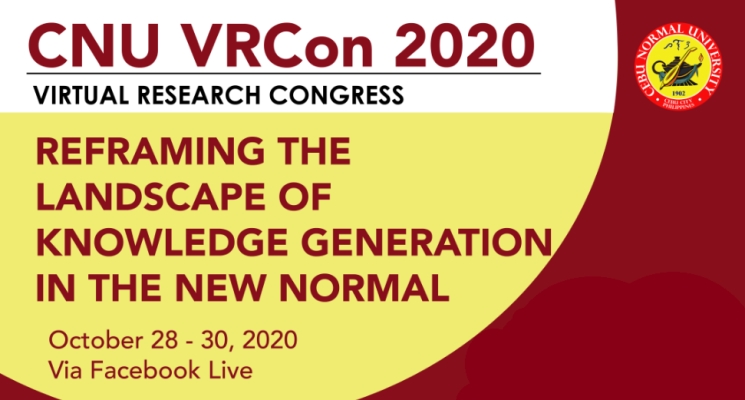
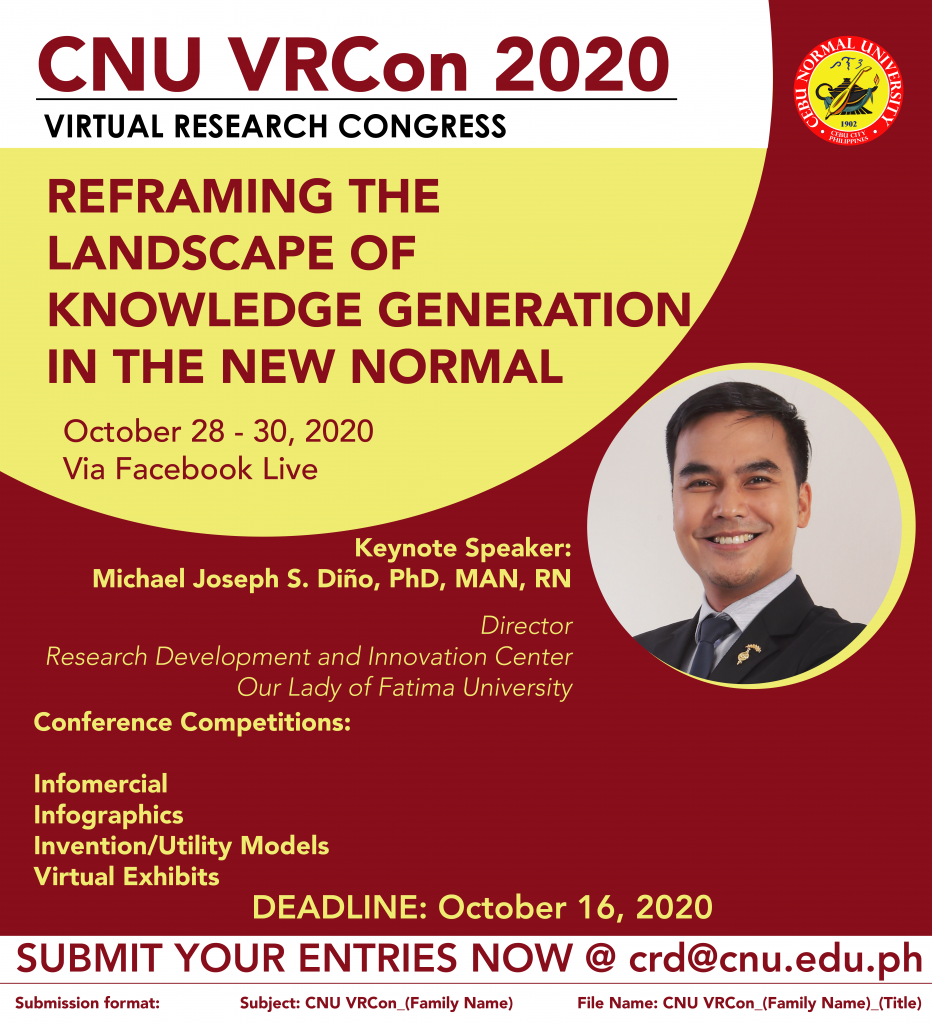
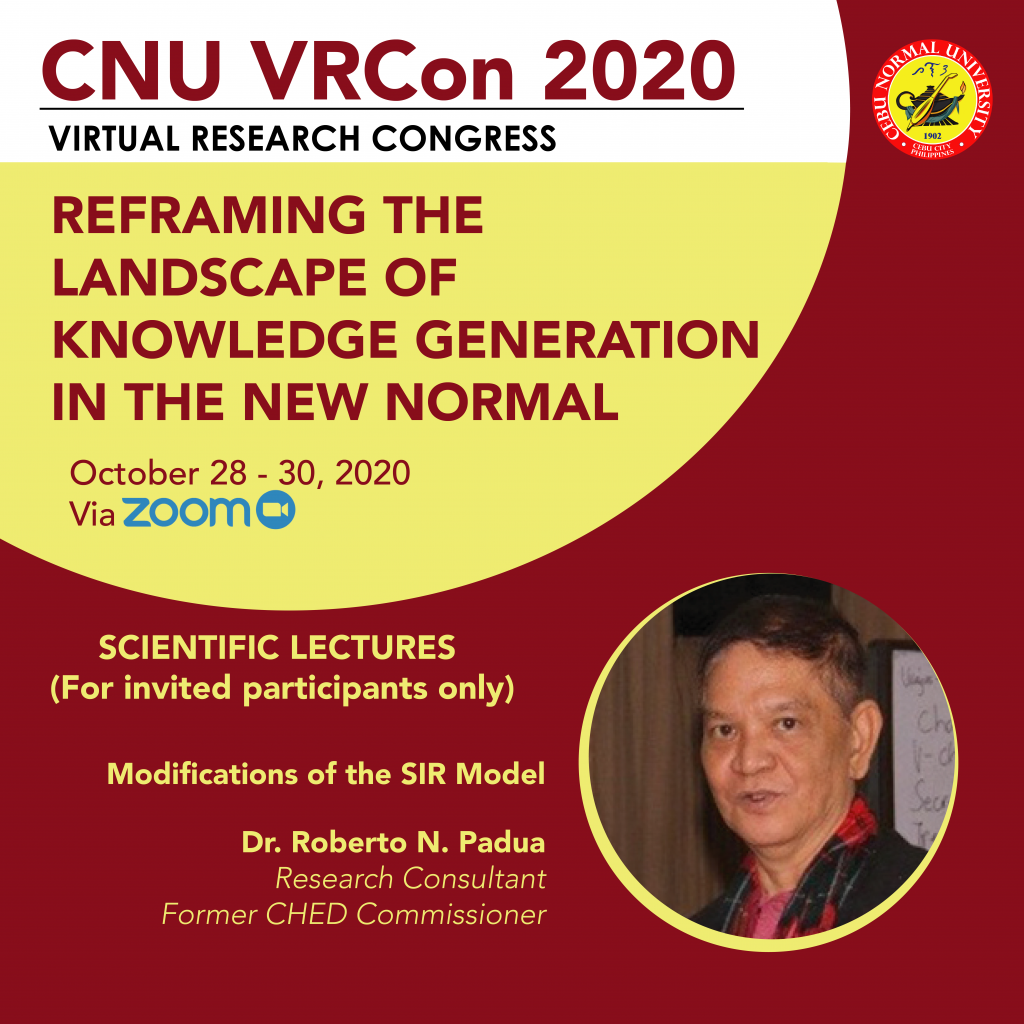
Theme: Reframing the Landscape of Knowledge Generation in the New Normal
Host: Cebu Normal University – Center for Research and Development
Date: October 29-30, 2020
Venue: Fb Live/Zoom Online Meetings
Participants: CNU Faculty Researchers and Administrative Officials
National and International Researchers
Activities:
Day 1 October 28, 2020
Online Check In Opening Ceremonies Keynote Speech
Launching of Competitions
Infomercial Competition Infographics Competition
Invention/Utility Models Competition Virtual Exhibits
Scientific Lectures (by invitation) Network Analysis
COVID-19 Mathematical Modelling
Day 2 October 29, 2020
Scientific Lectures (by invitation) Network Analysis
COVID-19 Mathematical Modelling
Day 3 October 30, 2020
Scientific Lectures (by invitation) Network Analysis
COVID-19 Mathematical Modelling
Announcement of Competition results End of Program
Expected Outcomes:
1. Developed new and common understanding on the knowledge generation processes and practices in the new normal;
2. Further collaboration in the research network;
3. Further publication of researches; and
4. Strengthen collaboration between research institutions
Submission of Entries
Submission will be done online through the official email address of the Center for Research and Development: crd@cnu.edu.ph
Submissions must follow the following format: Subject: CNU VRCon_(Family Name)
Attachments:
File Name: CNU VRCon_(Family Name)_(Title) Deadline: October 16, 2020
a. Virtual Exhibits*
Background: The virtual exhibits serve as a way to promote research activities and facilities as well as an avenue to showcase the accomplishments and/or research services of participating units/institutions.
Guidelines:
a. Units/participating institutions can create a video exhibit showcasing best research practices.
b. The exhibit must contain the following: (1) the unit/participating institutions’ research activities or facilities, or R&D accomplishments and (3) showcase best research practices.
c. At least 2 research studies according to the THEME of the research conference must be featured by the units/participating institutions.
d. A panel of 3 judges shall evaluate all entries and identify a winner.
e. Participating exhibitors must have their virtual exhibit completed on or before October 16, 2020, 5:00 PM.
f. The decision of the panel of judges shall be final and unappealable. The scorecards or rating sheets are considered personal notes of the Panel of Judges and are not for public scrutiny and any part of it shall not be given to any contestant or requesting party.
Judging shall be based on the following criteria:
Criteria | Scoring |
Virtual Exhibit Concept (quality, originality and uniqueness) | 25% |
Content (intended message is communicated clearly to a wide audience) | 30% |
Branding (use of the unit/participating institutions’ logo within the design of the booth) | 15% |
Creativity (promotion and presentation of research services) | 20% |
Over-all appeal (booth cleanliness; layout attractiveness; ease of access to information within the booth) | 10% |
| TOTAL | 100% |
*Adapted from CVCHRD Guidelines
b. Invention/Utility Models****
i. A. Definition: Invention refers to any technical solution of a problem in any field of human activity which is new, involves an inventive step and is industrially applicable. It may be, or may relate to a product, or process, and their improvements, (Sec. 21, RA 8293). It shall be covered by invention patent still in force granted by the Intellectual Property Office – Philippines (IPOPHIL)
B. Definition: Utility model refers to any technical solution of a problem in any field of human activity which is new and industrially applicable contemplation of the above statute (Sec. 109, RA 8293). It shall be covered by utility model registration with a registrability report still in force granted by the Intellectual Property Office of the Philippines (IPO-PHIL).
Guidelines:
a. Entries in the invention/utility models category must have patent or utility model registration from IPOPHL with its corresponding documents.
b. All inventor(s) must sign in the entry forms.
c. Documentation of invention(s)/utility model(s) shall be sent to the Official Email of the CRD.
d. The prototype can be exhibited according the discretion of the inventor. Several ways for presenting can be utilized in the presentation of the utility models.
e. Participating exhibitors must have their virtual exhibit completed on or before October 16, 2020, 5:00 PM.
f. The decision of the panel of judges shall be final and unappealable. The scorecards or rating sheets are considered personal notes of the Panel of Judges and are not for public scrutiny and any part of it shall not be given to any contestant or requesting party.
Judging shall be based on the following criteria:
A. INVENTION
| Criteria | Scoring | ||
| Degree of Inventiveness | 30% | ||
| Degree of Development | 25% | ||
| Commercial Viability/Readiness for Commercialization | 40% | ||
| Presentation and Demonstration | 5% | ||
| TOTAL | 100% |
B. UTILITY MODEL
Criteria | Scoring |
Useful technical advantage | 30% |
Degree of Development | 25% |
Commercial Viability/Readiness for Commercialization | 40% |
Presentation and Demonstration | 5% |
TOTAL | 100% |
****Adapted and modified from DOST 2019 RICE Rules and Criteria
c. Research Infomercial*****
Definition: An infomercial is a video presentation which presents a significant amount of information to promote a point of view.
Guidelines:
a. Units/participants can submit an entry for the Research Infomercial Competition.
b. The maximum running time of the infomercial is 2 minutes only and must not be shorter than 30 seconds.
c. The infomercial must be based on the THEME of the research conference.
d. The infomercial must portray why such project was developed or why the study was conducted; the study’s potential benefits in terms of its impact to the society as a whole.
e. The infomercial can be a slideshow of pictures and captions and can also be a video production. It must be in DVD playable format. To enhance the audio and video presentation, subtitles may be used to transcribe the conversations. It must be ensured that the text is visible. Use of the Filipino and/or English as medium is allowed.
f. All created infomercials must be original and no part of it must be obtained from any shows or television commercials. Any violation will void the entry.
g. Upon submission of the entry, the entrants give the Center for Research and Development the permission to use the submitted material for the express purpose of research promotion and publicity.
h. Entries may be submitted individually, in groups, or as a unit. The submitted entry must have the name and e-mail address of the contact person and the identifying institution to avoid technicality problems. Finalists will be contacted via email.
i. Deadline of submission of the entries will be on October 16, 2020, 5:00 PM.
j. All entries will be posted on the official Facebook page of the university. Likes and shares will be part of the criteria. The opening of the research festival, i.e. on the first day of the research festival, signals the time allotted to promote the entries in social media and ends in the morning at 11:59 AM of the last day. No entries shall be accepted once the campaign has already started.
k. The decision of the panel of judges shall be final and unappealable. The scorecards or rating sheets are considered personal notes of the Panel of Judges and are not for public scrutiny and any part of it shall not be given to any contestant or requesting party.
Judging shall be based on the following criteria:
Criteria | Scoring |
Story and Creativity | 25% |
Novelty | 20% |
Content/Relevance | 40% |
Fan Page Results Likes 75% Shares 25% | 15% |
TOTAL | 100% |
*****Adapted from CVCHRD Guidelines
d. Research Infographics******
Definition: An infographic is a visual way to display data that makes it easy to understand at a glance. It can take the form of a chart, diagram, or illustration, and usually involves minimal text.
Guidelines:
a. Units/participants can submit an entry for the Research Infographics Competition.
b. The infographics should highlight the THEME of the research conference.
c.
d. Entries may be submitted individually, in groups, or as a unit. The submitted entry must have the name and e-mail address of the contact person and the identifying institution to avoid technicality problems. Finalists will be contacted via e-mail.
e. The infographics may be submitted on either .jpeg or .pdf format.
f. Deadline of submission of the entries will be on October 16, 2020, 5:00 PM.
g. All entries will be posted on the official Facebook page of the university. Likes and shares will be part of the criteria. The opening of the research festival, i.e. on the first day of the research festival, signals the time allotted to promote the entries in social media and ends in the morning at 11:59 AM of the last day. No entries shall be accepted once the campaign has already started.
h. The decision of the panel of judges shall be final and unappealable. The scorecards or rating sheets are considered personal notes of the Panel of Judges and are not for public scrutiny and any part of it shall not be given to any contestant or requesting party.
Judging shall be based on the following criteria:
Criteria | Scoring |
Visual Appeal | 40% |
Quality of Content | 40% |
Potential to Generate Discussion | 5% |
Fan Page Results Likes 75% Shares 25% | 15% |
TOTAL | 100% |
******Adapted from CVCHRD Guidelines
*This announcement is made through the request of the Center for Research and Development