Menu

Philippine Standard Time:

RESEARCH INSTITUTE FOR AGEING AND HEALTH (RIAH)

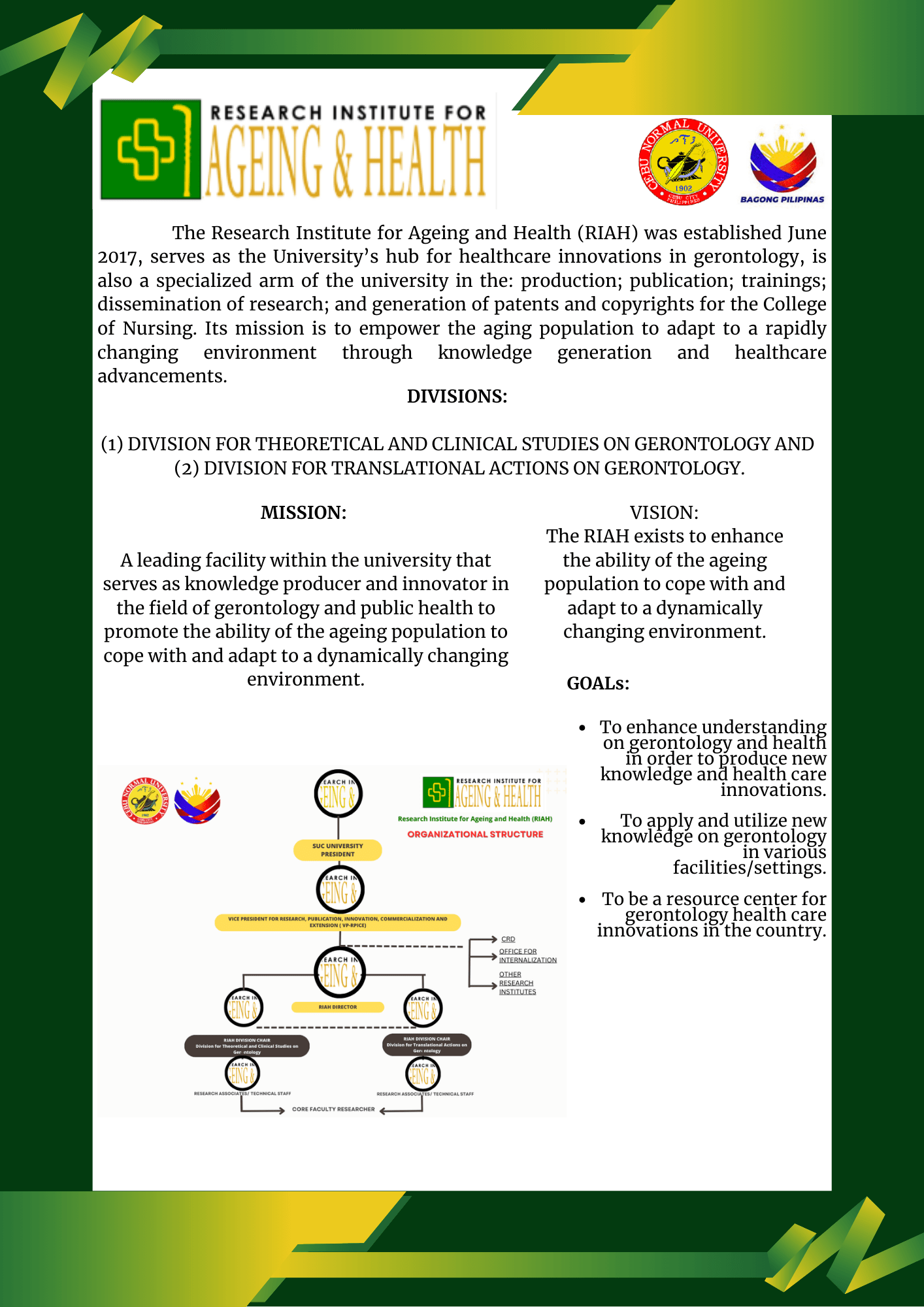
Goals

To enhance understanding on gerontology and health in order to produce new knowledge and health care innovations.

To enhance understanding on gerontology and health in order to produce new knowledge and health care innovations.

Goals

To apply and utilize new knowledge on gerontology in various facilities/settings.

To be a resource center for gerontology health care innovations in the country.

ABOUT RIAH

Latest Updates

Research Institute for Ageing and Health (RIAH) Updates 2024 Trainings and Ativities Conducted  HALAD PANGALAGAD- CCMC CN GRAND ALUMNI HOMECOMING Read more
Medical-Dental MissionDecember 09, 2023Sanctuario di Padre Pio - Cebu, Pulang Batoorganized by ST PADRE PIO CONTEMPLATIVE COMMUNITY CEBU FOUNDATIONin cooperation Read more
Seminar: Elderly Care in Denmark on November 14, 2023 at E-classrom Research Institute of Ageing and Health; University of Cebu; Read more
It's ICONS Season once again!Through the years, the International Conference of Nurses (ICONS) has been established as a momentous face- Read more
The Research Institute for Ageing and Health (RIAH) of Cebu Normal University conducted a Senior’s Day in Brgy. Tabunan, Cebu Read more
Health research has high value to society. It can provide important information about disease trends and risk factors, outcomes of Read more

Announcements

Seminar-Workshop on the Writing Publishable Medical and Health Research on November 20, 2023 at Marco Polo Hotel, Cebu

Implementing units: VP-RPICE, CRDP, COM and Research Institute of Ageing and Health (RIAH)

Aligned with the strategic directions of the Research Institute for Ageing and Health (RIAH) to be a resource center for gerontology and health in the country, we aim to produce and develop quality research studies in ageing and gerontology health care innovations.

To realize this, we will be conducting a three-day research write-shop on March 29-31, 2021 via Zoom Video communications with Dr. Evalyn Abalos.

Medical-Dental MissionDecember 09, 2023Sanctuario di Padre Pio - Cebu, Pulang Batoorganized by ST PADRE PIO CONTEMPLATIVE COMMUNITY CEBU FOUNDATIONin cooperation Read more
Seminar: Elderly Care in Denmark on November 14, 2023 at E-classrom Research Institute of Ageing and Health; University of Cebu; Read more
It's ICONS Season once again!Through the years, the International Conference of Nurses (ICONS) has been established as a momentous face- Read more
The Research Institute for Ageing and Health (RIAH) of Cebu Normal University conducted a Senior’s Day in Brgy. Tabunan, Cebu Read more
Health research has high value to society. It can provide important information about disease trends and risk factors, outcomes of Read more

About

        The Research Institute for Ageing and Health (RIAH) is the center for health care innovations in the university in the field of gerontology. It envisions to promote the ability of the ageing population to cope with and adapt to a dynamically changing environment through knowledge generation and health care innovations.

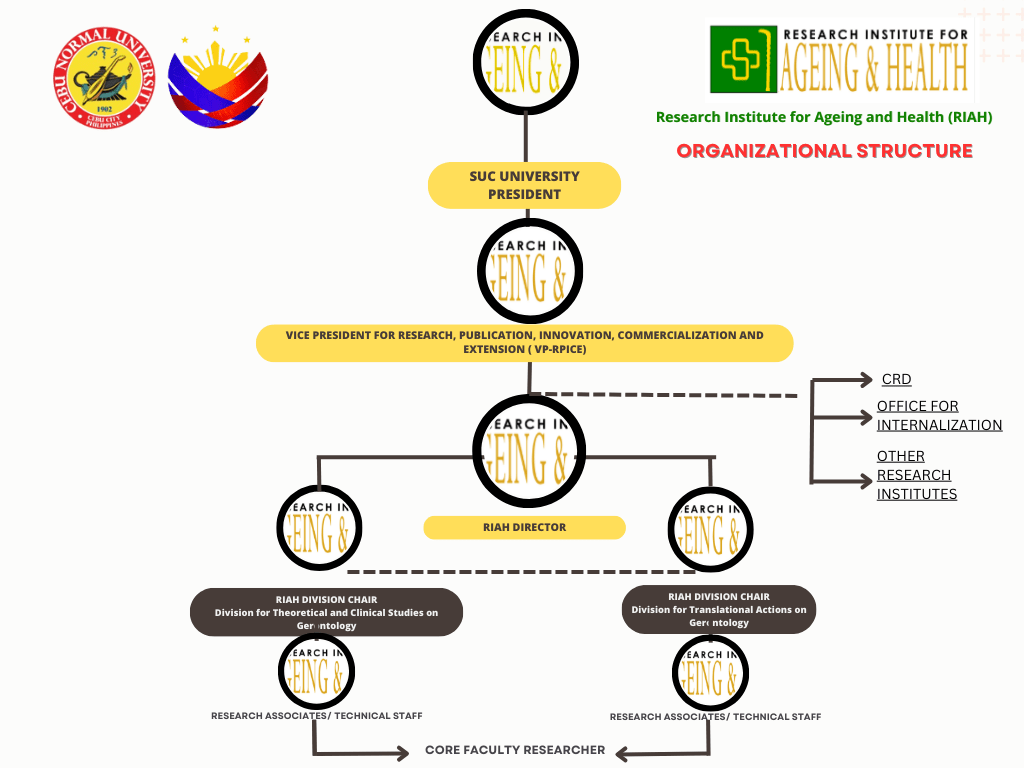
         RIAH has two divisions: (1) Division for Theoretical and Clinical Studies on Gerontology and (2) Division for Translational Actions on Gerontology. The institute will develop and validate new gerontology care frameworks, generate and publish articles in ISI or Scopus-indexed journals and produce patents on innovative technologies. Furthermore, aims to assist the University in capacitating the regular faculty in health care research, establish partnership/linkages with other organizations and funding agencies and create a Gerontology Resource Center (GRC) and consultancy/expert services on gerontology.

         RIAH is under the direct supervision of the Vice President for Research, Extension and Publication (VP-REP) and is managed by the Institute Director with division chair/s, core faculty researchers and an office staff.

VISION

A leading facility within the university that serves as knowledge producer and innovator in the field of gerontology and public health to promote the ability of the ageing population to cope with and adapt to a dynamically changing environment.

MISSION

The RIAH exists to enhance the ability of the ageing population to cope with and adapt to a dynamically changing environment.

Objectives

Conduct and publish researches relevant to gerontology.

To develop and validate new models in gerontology care in the context of the new normal era.

To produce and publish quality research studies in ageing and gerontology health care innovations.

To produce patents on innovative technologies in gerontology.

To provide opportunities for fellowship program and practicum

To conduct trainings and seminars on the gerontology care models that is appropriate to specific target clienteles.

To establish RIAH office with Gerontology Resource Center.

To provide various trainings on the knowledge and competencies in creating an environment that would address the health care needs of aging.

To establish consultancy services for elderly.

To establish partnership and linkages with other research institutions and funding agencies.

To offer gerontology specialized training/certificate programs

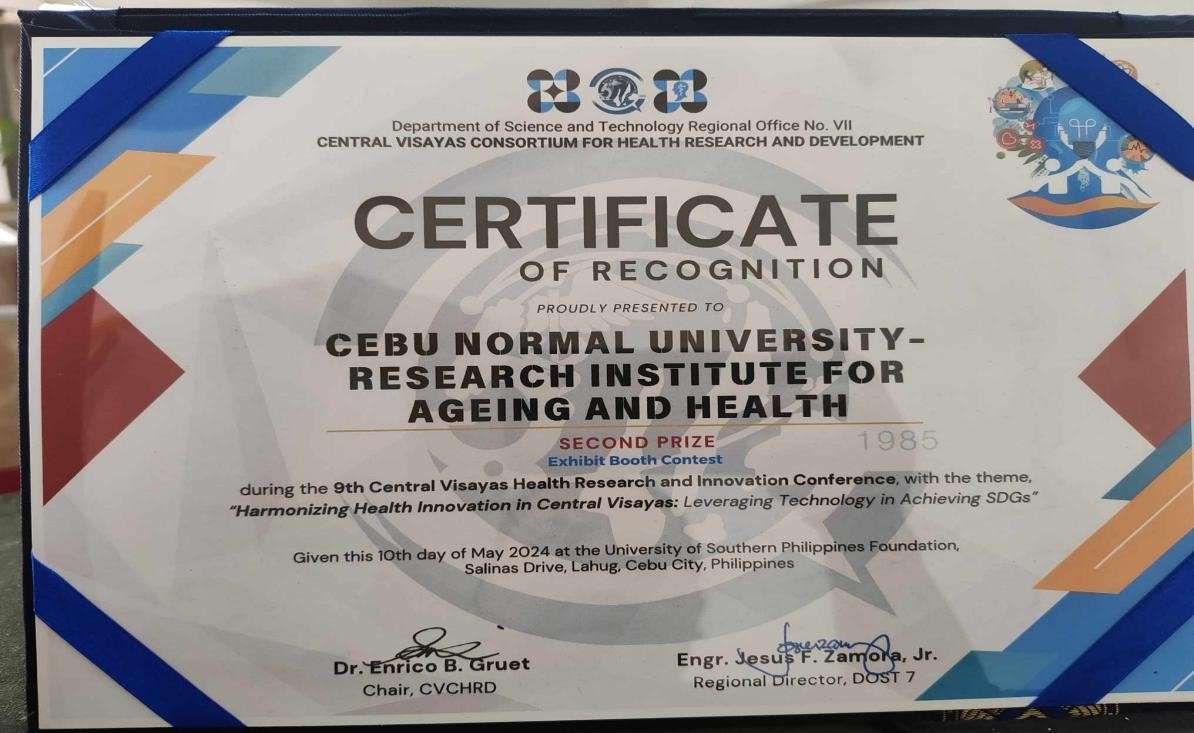
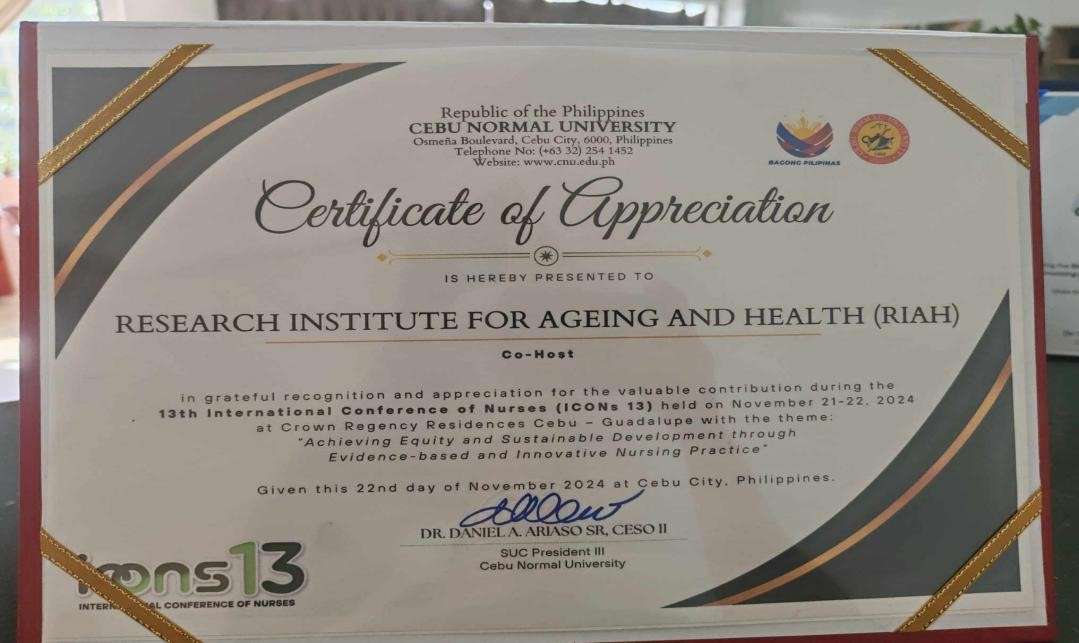
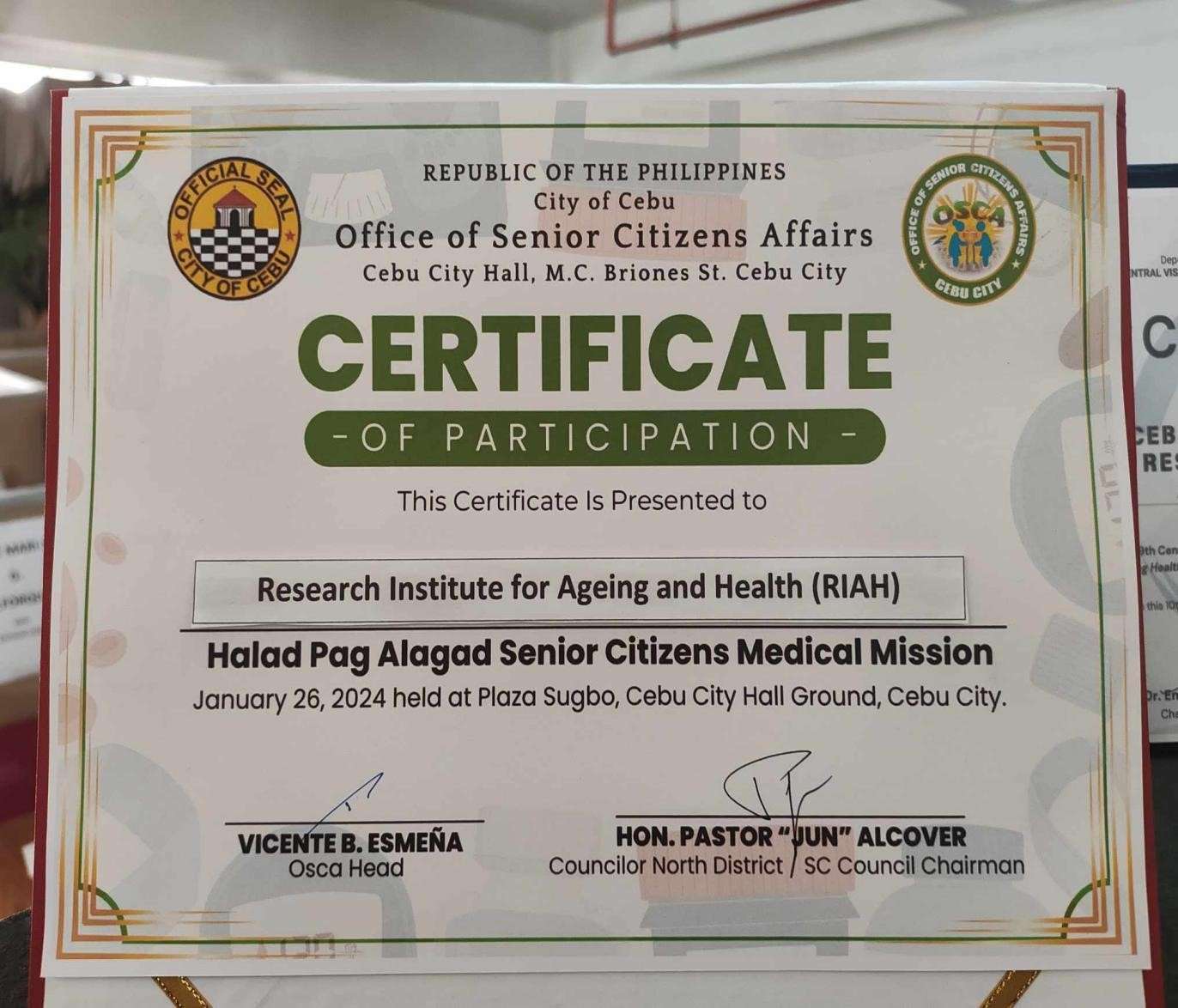
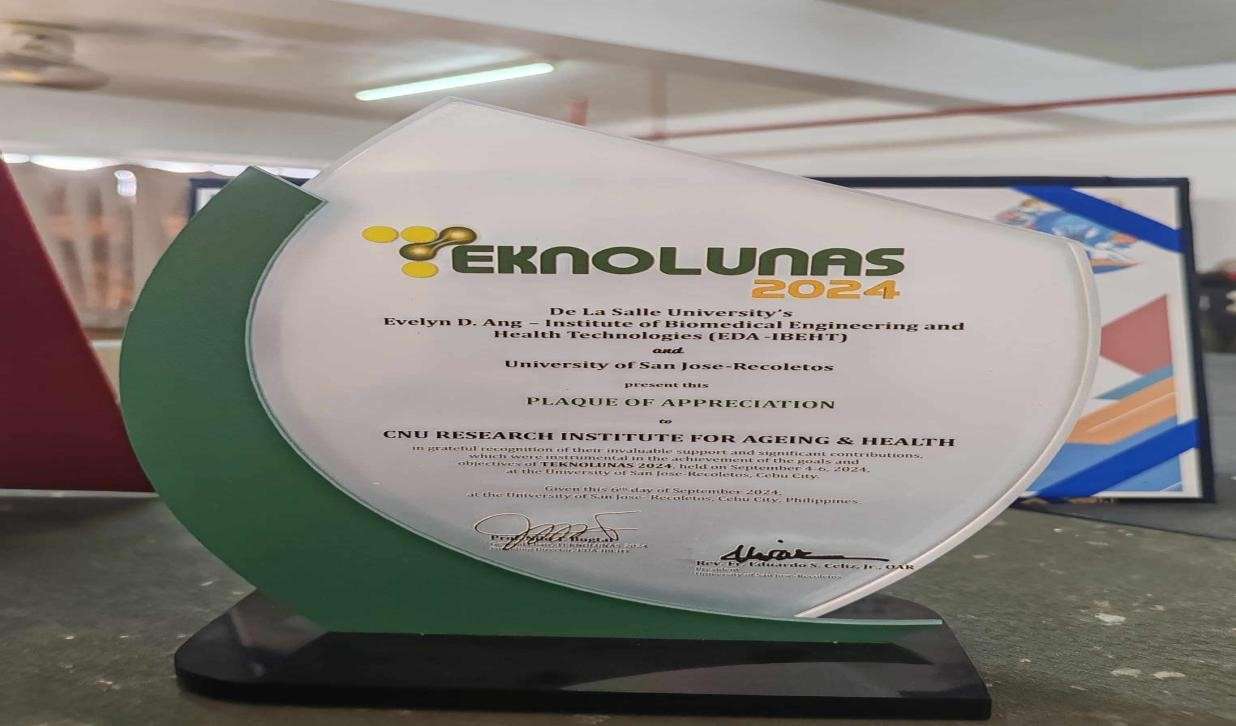
RIAH AWARDS AND RECOGNITION

RIAH STRATEGIC PLAN 2021-2024

GOALS
OBJECTIVES
INITIATIVES/
PLANNED ACTIONS
SUCCESS INDICATORS
BUDGET REQUIREMENT
To enhance understanding on gerontology and health in order to produce new knowledge and health care innovations.
1. To conduct and publish researches relevant to gerontology.
Initiate commissioned research projects/programs aligned with the institute thrusts.
Completed Research Papers

Published research papers in the refereed/ indexed journals
Sources may include, but not limited to, external funding agencies (DOST, DOH, CHED, etc) and CNU funds.
2. To develop and validate new models in gerontology care in the context of the new normal era.
Identify gaps or issues (such as pandemic leading to psychological and physiological issues among elderly) and use them as inputs for the development of new gerontology models of care.
Development of new elderly care frameworks (such as utilization of SIR model).
Sources may include, but not limited to, external funding agencies (DOST, DOH, CHED, etc) and CNU funds.
3. To produce and publish quality research studies in ageing and gerontology health care innovations. (Ex. Category-based health care innovations for elderly by categorizing clients (according to access and net capability).
Initiate commissioned research projects/programs aligned with the institute thrusts.
Completed Research Papers

Published research papers in the refereed/ indexed journals.


GOALS
OBJECTIVES
INITIATIVES/
PLANNED ACTIONS
SUCCESS INDICATORS
BUDGET REQUIREMENT
Establish a Bi-annual call (April and August) for research project submission on gerontology and health care innovations.
Disseminated Call for Research projects on gerontology every April and August of the year
Conduct In-house Review of Proposals /Vetting of research project submission (technical review, ethical clearance and similarity index)
Evaluated submitted projects on technical and ethical soundness
100,000.00
Approval and funding of proposals
Signed MOAs
Conduct and monitor the research implementation based on MOA
No. of research conducted
Monthly progress reports
Conduct research in collaboration with visiting fellows and experts on gerontology care
Commissioned research
200,000.00
Submit proposals for external funding to various funding agencies such as DOH, DOST, CVCHRD and CHED.
No of externally-funded research projects
External funds
Conduct research write shops/trainings on gerontology health research and writing publishable articles training such as development of elderly care models and other up-to-date innovations for elderly
No of trainings and write shops
150,000.00
GOALS
OBJECTIVES
INITIATIVES/
PLANNED ACTIONS
SUCCESS INDICATORS
BUDGET REQUIREMENT
To produce patents on innovative technologies in gerontology.
Identify research outputs with potential outputs for patenting
Specialized training focus
Infection control patents
Provide technical and financial support for patent procedures
50,000.00
Invite the experts from IPOPhil to conduct orientation and training on IPR and patents of gerontology technologies.
Conducted IPOPhil training
100,000.00
Commercialization of patents, copyrights and modules produced

Commercialization IRR
25,000.00
GOALS
OBJECTIVES
INITIATIVES/
PLANNED ACTIONS
SUCCESS INDICATORS
BUDGET REQUIREMENT
2. To apply and utilize new knowledge on gerontology in various facilities/settings.
1. To conduct trainings, conferences and fora on the gerontology care models that are appropriate to specific target clienteles.
1. Hosting of trainings, seminars and conferences related to trends and advancements on gerontology care (ex. ICONs)
Number of trainings/seminars/conferences
1M
GOALS
OBJECTIVES
INITIATIVES/
PLANNED ACTIONS
SUCCESS INDICATORS
BUDGET REQUIREMENT
3. To be a resource center for gerontology and health in the country.
1. To establish RIAH office and Gerontology Resource Center (GRC).
(TAC ground floor)

1. Create RIAH office and Gerontology Wellness Center- a collaborative project with GO and NGOs catering to the needs of senior citizens which will serve as an avenue for implementation of care for older adults.
Established RIAH Office and Gerontology Resource Center


200,000.00

Included in the PPMP 2021
(DOH/CHED grant will integrate)

2. Hire a gerontology specialist/ Consultant or experts on a need-based contracting
Need-based consultancy
600,000.00
3. Invest on equipment needed such as PC with licensed anti-virus, fast internet connection, e-journal on gerontology subscription, etc.
Procured supplies and equipment
100,000.00
4. Establish a rich data bank on gerontology and health care innovation.
Gerontology data bank available for use
100,000.00
5. Advertise the presence of GRC in the university and its available services.
Number of clients visiting the center
GOALS
OBJECTIVES
INITIATIVES/
PLANNED ACTIONS
SUCCESS INDICATORS
BUDGET REQUIREMENT
2. To provide various trainings on the knowledge and competencies in creating an environment that would address the health care needs of gerontology clients.
1. Offer Certificate Programs for Older Adult Care Approaches to target clientele such as caregivers, gerontology nurses and geriatric practitioners.
May check with the Masters and DSCN course/s to be offered as a short course/certificate program with crediting units.
Certificate Program on Gerontology Care Practice approved by the BOR
500,000.00
2. Apply for PRC certification on CPD units granting of trainings provided
CPD units granted
3. To establish consultancy services for elderly.
1. Create a pool of experts on gerontology and health care innovation
Gerontology Specialist Consultancy Services provided
2. To provide consultancy for wellness promotion among elderly
3. To provide services for GOs, NGOs and other agencies on policy making matters concerning the elderly.
Older Adult policy development and promotive services provided
Number of clients
4. Provide expert services for students (undergrad and graduate) on gerontology issues
Number of clients served
5. Formulate IRR for consultancy services.
IRR approved for implementation
GOALS
OBJECTIVES
INITIATIVES/
PLANNED ACTIONS
SUCCESS INDICATORS
BUDGET REQUIREMENT
4. To establish partnership and linkages with other research institutions, funding agencies and NGOs.
1. Create a network of experts on gerontology who can complement with the core researchers.
Pool of experts
2. Conduct rounds of bilateral academic dialogues
100,000.00
3. Formalize linkages with MOAs with other public and private, domestic and foreign agencies and organizations (GCCI, DOST, CHED) to avail programs on balik scientist, STRIDE, visiting fellows, adopt-a-training/conference.
No of BOR-approved linkages
4. To make the public aware of the existence of RIAH and its services through close collaboration with the Institute Public Relations Officers and CNU PIO and Radio Barn and Community linkages.
Radio advertisement, promo ads, infographics/informercial.

ORGANIZATIONAL CHART

Contact Information

DR. LOVELYN G. TIPON
DIRECTOR, RESEARCH INSTITUTE FOR AGEING AND HEALTH
(RIAH)
Official email: tiponl@cnu.edu.ph

DR. JOSE MARI LOUIS G. ALFORQUE
DIVISION CHAIR, RESEARCH INSTITUTE FOR AGEING AND
HEALTH (RIAH)
Official email: alforquej@cnu.edu.ph

DR. REMAUR HERRERA
DIVISION CHAIR, RESEARCH INSTITUTE FOR AGEING AND
HEALTH (RIAH)
Official email: herrerar@cnu.edu.ph

X
Cebu Normal University

PRIVACY POLICY

Policy Statement

This Privacy Policy is adopted in compliance with the Data Privacy Act of 2012 (Republic Act No. 10173), its Implementing Rules and Regulations (IRR), and other relevant issuances of the National Privacy Commission (NPC). The University is committed to protecting and respecting your personal data privacy. We process personal information in accordance with the principles of transparency, legitimate purpose, and proportionality. This Policy informs how we collect, use, disclose, store, protect, and dispose personal information of our data subjects.

Definitions

Personal information refers to any information, whether recorded in a material form or not, from which the identity of an individual is apparent or can be reasonably and directly ascertained by the entity holding the information or when put together with other information that would directly and certainly identify an individual.

Sensitive information is a type of personal information with the risk of discrimination against the Data Subject. These are about an identifiable person’s racial or ethnic origin, marital status, color, and religious, philosophical, or political affiliations. It is also, about an individual’s health, education, the genetic or sexual life of person, or any proceeding for any offense committed or alleged to have been committed by such person, the disposal of such proceedings, or the sentence of any court in such proceedings; Issued by government agencies peculiar to an individual which includes, but not limited to, social security numbers, previous or current health records, licenses or its denials, suspension or revocation, and tax returns; and specifically established by an executive order or an act of Congress to be kept classified.

Privileged information refers to any and all forms of data which under the Rules of Court and other pertinent laws constitute privileged communication.

Information We Collect

The University may collect personal information in the context of its regular functions — including but not limited to the following categories:

  1. Students: contact and enrollment details, academic records, health or medical records, accommodation records, student-activity participation, and related data.
  2. Staff and job applicants: contact details, employment history, qualifications, employee-related data.
  3. Alumni profiling: contact and demographic details.
  4. Visitors, volunteers, and other stakeholders: information collected through sign-in forms, CCTV or security monitoring, photos or recordings during official events, surveys, and feedback forms.

Collection may occur by any medium, including: paper forms, electronic forms, email, website or online platforms, CCTV or video/photographic capture, surveys/questionnaires, and other lawful means.

Purposes and Uses of the Data Collected and Processed

Personal information collected may be used for:

  1. Administration of admission, enrollment, employment, alumni relations, and other official functions.
  2. Maintenance of student and employee records, including academic, health, and administrative data.
  3. Provision of University services such as counseling, scholarship administration, placement, library access, facilities use, laboratory access, security, parking, and accommodation.
  4. Internal research, quality assurance, performance monitoring, and institutional planning.
  5. Compliance with statutory obligations (e.g. reporting to government agencies when required).
  6. Security, safety, and campus management, including CCTV monitoring.

Legal Basis / Lawful Criteria for Processing

All processing of personal data is carried out in accordance with the legality, fairness, and lawfulness requirements under the Data Privacy Act and IRR.
Where applicable, processing is grounded on consent, contract, legal obligation, legitimate interest, or other lawful bases recognized under the law. The choice of lawful basis depends on the nature of data, the purpose of processing, and legal or contractual requirements.

Manner of Collection and Processing

Personal data may be collected through physical forms (paper-based), electronic forms, online or web-based platforms (e.g., registration portals, email, institutional website), CCTV or video/photo capture (for security or surveillance), event sign-in sheets or registration forms, surveys or questionnaires, or other legitimate and lawful means.

Processing may include collection, recording, sorting, storing, retrieval, use, updating, modification, blocking, destruction or other operations as allowed under the law, consistent with declared purposes.

Disclosure of Information

The University does not disclose personal information except under the following circumstances:

  1. Internal disclosure within authorized University personnel, only when necessary and appropriate for legitimate institutional purposes.
  2. External disclosure only when required or permitted by law (e.g. statutory obligations), or when the data subject has provided valid consent.
  3. Sensitive personal information or privileged information is processed and disclosed only in accordance with relevant legal provisions.

Risks, Safeguards and Security Measures

The University recognizes that processing of personal data entails certain privacy and security risks. Accordingly, we implement appropriate organizational, technical, and physical security safeguards to protect the confidentiality, integrity, and availability of personal data — whether in electronic or physical form. Such measures include (but are not limited to):

  1. Access controls (both digital and physical) to restrict access only to authorized personnel
  2. Use of secure storage: locked filing cabinets or secure rooms for physical records; password-protected systems, encryption, secure servers, firewalls for electronic data
  3. Secure transmission of data (when shared or transferred), secure printing and disposal protocols, and safe deletion or destruction of data when no longer needed
  4. Classification of data and periodic review of security protocols, to ensure adequacy in light of the risks presented and sensitivity of the data processed

Rights of Data Subjects

Under the Data Privacy Act and its IRR, data subjects have the following rights:

  1. Right to be informed — you have the right to know whether personal information about you will be, is being, or has been processed; the purposes of processing; the personal data to be entered; and the scope and method of processing.
  2. Right to access, correct, or update your data — you may request access to your personal information, ask for rectification of inaccuracies, or request updates.
  3. Right to object or withdraw consent — when processing is based on consent or legitimate interest, you may withdraw consent or object, subject to legal limits.
  4. Right to data portability — where applicable, you may obtain a copy of your personal data in a secure and portable format for transfer to another controller.
  5. Right to erasure or blocking — if personal data is incomplete, outdated, unlawfully obtained or processed, no longer necessary, or processing is unauthorized, you may request erasure or blocking, subject to legitimate grounds for retention (e.g. legal obligations or defense of legal claims).
  6. Right to damages — you may seek indemnification for damages resulting from inaccurate, incomplete, outdated, unlawfully obtained or unauthorized use of your personal data.
  7. Right to lodge a complaint with the NPC if you believe your data privacy rights have been violated.

Requests for access, rectification, objection, portability, erasure or complaints may be submitted in writing to the University’s designated Data Protection Officer (DPO) or Data Privacy Office.

Security, Retention, and Disposal

The University implements appropriate organizational, technical, and physical security measures to safeguard personal data — whether in paper or electronic form — against unauthorized access, disclosure, alteration, or destruction. Such measures include: secure storage (locked filing cabinets or rooms), restricted access to authorized personnel only, use of locked screens/screensavers, secure transmission (sealed envelopes or secure electronic transmission), secure printing and disposal of documents, and safe deletion or destruction of data when no longer needed.

Personal data will be retained only for as long as necessary to fulfill the declared and legitimate purposes, or as required for legal obligations or defense of legal claims. When no longer needed, personal data will be disposed of securely in accordance with University policy and relevant data-protection guidelines.

Consent, Notice, and Legitimate Processing

Where required by law, consent will be obtained from data subjects prior to collection or processing of their personal or sensitive data. In other cases (e.g. CCTV monitoring, legitimate interest), the University will inform data subjects through appropriate notice mechanisms before or at the time of data collection. Privacy notice(s) will accompany data-collection forms or be posted in conspicuous campus areas, and on the University website. At all times, data processing is based on legitimate purpose and proportional to the need.

Data Subject Access and Contact

To exercise your rights or if you have any inquiry, concern, or request regarding your personal data, please contact:

Omar B. Roma

Data Protection Officer
Email: dpo@cnu.edu.ph
Phone: 09422041421

Changes to This Policy

The University reserves the right to update or amend this Privacy Policy as necessary to reflect changes in applicable laws, regulations, regulatory guidance, or its internal data-processing practices. Updated versions will be posted on the University’s official website and, where appropriate, communicated to data subjects.