Cebu Normal University
THE OFFICE FOR INTERNATIONALIZATION & GLOBAL CITIZENSHIP

Empathy: The starting point of healing

Perhaps there is no one else who can have more direct physical contact with those infected by the Coronavirus Disease 2019 (COVID-19) than the nurses and doctors who are working in the hospitals. It is not just in time of the pandemic that they are called to serve those who are ill but in every situation that calls for medical assistance.

Nurses, doctors, hospital staff, and all those who are working in the healthcare field may grow weary after a long day’s work especially with the current health crisis. Some get used to the daily jostle while others look forward to untangling the difficulties for the day only to undergo the same ordeal the next day. But one thing is for sure, they feel satisfied after having done everything just to save someone else’s life.

It takes knowledge, training, and experience for them to perform to the best of their abilities. They could be likened to any soldier groomed and prepared for battle. As with anything, it all starts with a single step.

Everyone has his/her story.

Mr. Calvin Dhame Lagahit, a Bachelor of Science (BS) in Nursing 2 student, realized sooner what certain characteristics a medical worker should possess. He recognized it in a community engagement he had in a certain barangay in his locality.

Recounting his experience, he recently won 3rd Place in the Essay Writing Contest 2020 organized by the Association of Deans of Philippine Colleges (ADPCN) Cebu and the Philippine Nurses Association (PNA) Cebu with his entry “Empathy”.

He shared that as a young boy he was drawn to have an inquisitive mind for animals, but as he grew older he opted to take up Nursing to make his mother proud.

After a year, he fully developed the passion for Nursing after having a heartfelt and moving experience with a six-year-old patient in a barangay he was assigned in.

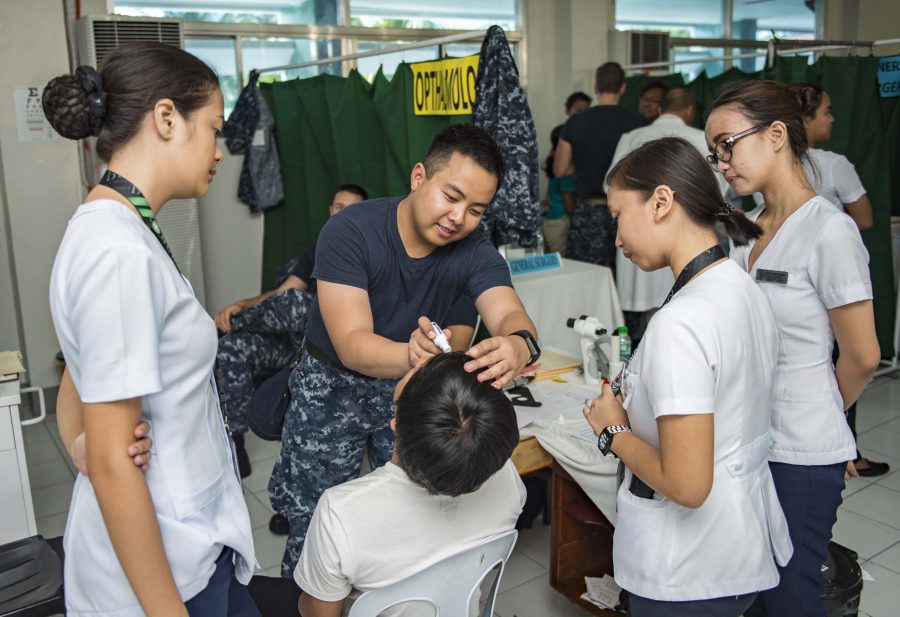
His patient who lived with her grandmother exhibited poor motor skills. She had a hard time balancing, catching a ball, and walking in a straight line. By the time he gave suggestions to the girl’s grandmother to see a pediatrician, eat balanced meals, and adopt cognitively engaging activities like reading and writing, he was informed that the young girl was traumatized after witnessing how her parents were arrested a year ago. The girl is said to have not been able to eat decently ever since.

He thought that student nurses who hoped to find patients who do not fit the normal standards of what it is to be healthy were selfish and wrong, but it dawned on him that what he took for selfishness was a necessity. He said that nurses needed to find despair and to empathize because they are capable of taking it away from people who suffer from it. 

He said that his love for the complexities of animals is still etched in him, but the birth of understanding; the even more complex matrix required to even scratch the surface to care for humans was a new passion.

He said that the world needs nurses, and it will continue permanently with the ongoing COVID-19 pandemic. He said that empathy is the universal starting point for people affected by any disease or illness to start healing. He said nurses are capable of giving it since empathy is an art and science nurses are trained for. (JDF)

Lagahit’s entry entitled “Empathy” is found below.

“Empathy”

by

Calvin Dhame C. Lagahit

I vividly recall pestering my parents to buy me sets of encyclopedias and other animal adorned book jackets I laid my eyes on whenever we visited the fully booked store. This inquisitive drive for knowledge came from my stubborn need to understand why animals, in all its plethoric variations, were so different yet still categorically boxed as beings that were levels below humans. My mother, although charmed with my little boy fantasies, wasn’t the most supportive about my endeavors. Fast-forward 13 years later and I found myself caught in an ultimatum to study either Biology, the field I‘d spent most of my free time manifesting to fruition, or the unthinkable alternative, Nursing. The choice was linear for me obviously, but against my better judgement and need to let my mother’s “little boy” be proud of him [sic], I opted for the Bachelor of Science in Nursing. I spent many days convincing myself that the degree’s inclination to cater the living was no different from a life science degree, but I was wrong. The difference was stark, I was disheartened about my decision. That however, changed completely after a year. 

In my second year, we had the opportunity to engage with communities. I was assigned in Barangay Punta where I met my 6-year-old patient. She lived with her grandmother, had big beady eyes, slender arms and legs, a small body frame, and a short stature. After a routine test to assess her development, I couldn’t ignore the evident stagnation of her fine and gross motor skills. She failed generally easy tasks like balancing on a leg for two seconds, catching an inflatable ball at close proximity, and walking in a straight line. As student nurses, we’re expected to get excited about patients that deviated from what’s standardly “healthy”. This to me was selfish. Willingly hoping to meet someone suffering from conditions that make living painful was wrong. I wasn’t the least bit excited about finding a “good” case, but I owe it to that girl and her family for the life-changing experience that made me see “nursing” in a different light. A day after, I visited them again to present my interventions. It wasn’t anything dramatic or difficult. I suggested that she see a pediatrician, eat balanced meals, and adopt cognitively engaging activities like reading and writing. The moments following my presentation were gut-wrenching. Her grandmother, teary-eyed, explained that this child witnessed both her parents get arrested at the age of 5. Traumatized by the loud blares of the sirens, she is petrified and cries uncontrollably at the sight of police cars. Despite her current family’s efforts, she hasn’t been able to eat decently ever since. I was at a complete loss for words. No simulations or return demonstrations could have prepared me for this. In that moment, I was supposed to be someone who can empathize and mediate all this concern, stay level-headed enough to assess and regurgitate significant information, and remain emotionally separate. I did what I thought I should’ve done at the time and told the family to seek help, it was so simple but their gratitude was overwhelming. They gave us potted plants and invited me over for lunch. As I politely declined their offer and bid my farewell, I could feel all the emotions welling up from the encounter and broke down in tears when I was completely out of sight. At the end of our shift, I still couldn’t wrap my head from what had happened. Is this what nursing was? An opportunity to be a therapeutic presence to someone at their most vulnerable? Do we voluntarily go through all that cacophonous turmoil of emotions with the hopes of saving someone? It dawned on me then that what I initially mistook for selfish was a necessity. Nurses needed to look for despair because they’re the only ones capable of taking people out from it. My love for the complexities of animals are still etched within me, but the birth of understanding the even more complex matrix required to even scratch the surface to care for humans was a new passion I became obsessed with. The world needs nurses, and it will continue to need them to no end. With the recent ongoing of the COVID 19 pandemic, I find myself looking back at that moment thinking what people like them need now more than ever. The universal answer I can only think of is the art and science that Nurses are trained for, empathy.


Cebu Normal University
PRIVACY POLICY

Policy Statement

This Privacy Policy is adopted in compliance with the Data Privacy Act of 2012 (Republic Act No. 10173), its Implementing Rules and Regulations (IRR), and other relevant issuances of the National Privacy Commission (NPC). The University is committed to protecting and respecting your personal data privacy. We process personal information in accordance with the principles of transparency, legitimate purpose, and proportionality. This Policy informs how we collect, use, disclose, store, protect, and dispose personal information of our data subjects.

Definitions

Personal information refers to any information, whether recorded in a material form or not, from which the identity of an individual is apparent or can be reasonably and directly ascertained by the entity holding the information or when put together with other information that would directly and certainly identify an individual.

Sensitive information is a type of personal information with the risk of discrimination against the Data Subject. These are about an identifiable person’s racial or ethnic origin, marital status, color, and religious, philosophical, or political affiliations. It is also, about an individual’s health, education, the genetic or sexual life of person, or any proceeding for any offense committed or alleged to have been committed by such person, the disposal of such proceedings, or the sentence of any court in such proceedings; Issued by government agencies peculiar to an individual which includes, but not limited to, social security numbers, previous or current health records, licenses or its denials, suspension or revocation, and tax returns; and specifically established by an executive order or an act of Congress to be kept classified.

Privileged information refers to any and all forms of data which under the Rules of Court and other pertinent laws constitute privileged communication.

Information We Collect

The University may collect personal information in the context of its regular functions — including but not limited to the following categories:

  1. Students: contact and enrollment details, academic records, health or medical records, accommodation records, student-activity participation, and related data.
  2. Staff and job applicants: contact details, employment history, qualifications, employee-related data.
  3. Alumni profiling: contact and demographic details.
  4. Visitors, volunteers, and other stakeholders: information collected through sign-in forms, CCTV or security monitoring, photos or recordings during official events, surveys, and feedback forms.

Collection may occur by any medium, including: paper forms, electronic forms, email, website or online platforms, CCTV or video/photographic capture, surveys/questionnaires, and other lawful means.

Purposes and Uses of the Data Collected and Processed

Personal information collected may be used for:

  1. Administration of admission, enrollment, employment, alumni relations, and other official functions.
  2. Maintenance of student and employee records, including academic, health, and administrative data.
  3. Provision of University services such as counseling, scholarship administration, placement, library access, facilities use, laboratory access, security, parking, and accommodation.
  4. Internal research, quality assurance, performance monitoring, and institutional planning.
  5. Compliance with statutory obligations (e.g. reporting to government agencies when required).
  6. Security, safety, and campus management, including CCTV monitoring.

Legal Basis / Lawful Criteria for Processing

All processing of personal data is carried out in accordance with the legality, fairness, and lawfulness requirements under the Data Privacy Act and IRR.
Where applicable, processing is grounded on consent, contract, legal obligation, legitimate interest, or other lawful bases recognized under the law. The choice of lawful basis depends on the nature of data, the purpose of processing, and legal or contractual requirements.

Manner of Collection and Processing

Personal data may be collected through physical forms (paper-based), electronic forms, online or web-based platforms (e.g., registration portals, email, institutional website), CCTV or video/photo capture (for security or surveillance), event sign-in sheets or registration forms, surveys or questionnaires, or other legitimate and lawful means.

Processing may include collection, recording, sorting, storing, retrieval, use, updating, modification, blocking, destruction or other operations as allowed under the law, consistent with declared purposes.

Disclosure of Information

The University does not disclose personal information except under the following circumstances:

  1. Internal disclosure within authorized University personnel, only when necessary and appropriate for legitimate institutional purposes.
  2. External disclosure only when required or permitted by law (e.g. statutory obligations), or when the data subject has provided valid consent.
  3. Sensitive personal information or privileged information is processed and disclosed only in accordance with relevant legal provisions.

Risks, Safeguards and Security Measures

The University recognizes that processing of personal data entails certain privacy and security risks. Accordingly, we implement appropriate organizational, technical, and physical security safeguards to protect the confidentiality, integrity, and availability of personal data — whether in electronic or physical form. Such measures include (but are not limited to):

  1. Access controls (both digital and physical) to restrict access only to authorized personnel
  2. Use of secure storage: locked filing cabinets or secure rooms for physical records; password-protected systems, encryption, secure servers, firewalls for electronic data
  3. Secure transmission of data (when shared or transferred), secure printing and disposal protocols, and safe deletion or destruction of data when no longer needed
  4. Classification of data and periodic review of security protocols, to ensure adequacy in light of the risks presented and sensitivity of the data processed

Rights of Data Subjects

Under the Data Privacy Act and its IRR, data subjects have the following rights:

  1. Right to be informed — you have the right to know whether personal information about you will be, is being, or has been processed; the purposes of processing; the personal data to be entered; and the scope and method of processing.
  2. Right to access, correct, or update your data — you may request access to your personal information, ask for rectification of inaccuracies, or request updates.
  3. Right to object or withdraw consent — when processing is based on consent or legitimate interest, you may withdraw consent or object, subject to legal limits.
  4. Right to data portability — where applicable, you may obtain a copy of your personal data in a secure and portable format for transfer to another controller.
  5. Right to erasure or blocking — if personal data is incomplete, outdated, unlawfully obtained or processed, no longer necessary, or processing is unauthorized, you may request erasure or blocking, subject to legitimate grounds for retention (e.g. legal obligations or defense of legal claims).
  6. Right to damages — you may seek indemnification for damages resulting from inaccurate, incomplete, outdated, unlawfully obtained or unauthorized use of your personal data.
  7. Right to lodge a complaint with the NPC if you believe your data privacy rights have been violated.

Requests for access, rectification, objection, portability, erasure or complaints may be submitted in writing to the University’s designated Data Protection Officer (DPO) or Data Privacy Office.

Security, Retention, and Disposal

The University implements appropriate organizational, technical, and physical security measures to safeguard personal data — whether in paper or electronic form — against unauthorized access, disclosure, alteration, or destruction. Such measures include: secure storage (locked filing cabinets or rooms), restricted access to authorized personnel only, use of locked screens/screensavers, secure transmission (sealed envelopes or secure electronic transmission), secure printing and disposal of documents, and safe deletion or destruction of data when no longer needed.

Personal data will be retained only for as long as necessary to fulfill the declared and legitimate purposes, or as required for legal obligations or defense of legal claims. When no longer needed, personal data will be disposed of securely in accordance with University policy and relevant data-protection guidelines.

Consent, Notice, and Legitimate Processing

Where required by law, consent will be obtained from data subjects prior to collection or processing of their personal or sensitive data. In other cases (e.g. CCTV monitoring, legitimate interest), the University will inform data subjects through appropriate notice mechanisms before or at the time of data collection. Privacy notice(s) will accompany data-collection forms or be posted in conspicuous campus areas, and on the University website. At all times, data processing is based on legitimate purpose and proportional to the need.

Data Subject Access and Contact

To exercise your rights or if you have any inquiry, concern, or request regarding your personal data, please contact:

Omar B. Roma

Data Protection Officer
Email: dpo@cnu.edu.ph
Phone: 09422041421

Changes to This Policy

The University reserves the right to update or amend this Privacy Policy as necessary to reflect changes in applicable laws, regulations, regulatory guidance, or its internal data-processing practices. Updated versions will be posted on the University’s official website and, where appropriate, communicated to data subjects.