Menu

Philippine Standard Time:
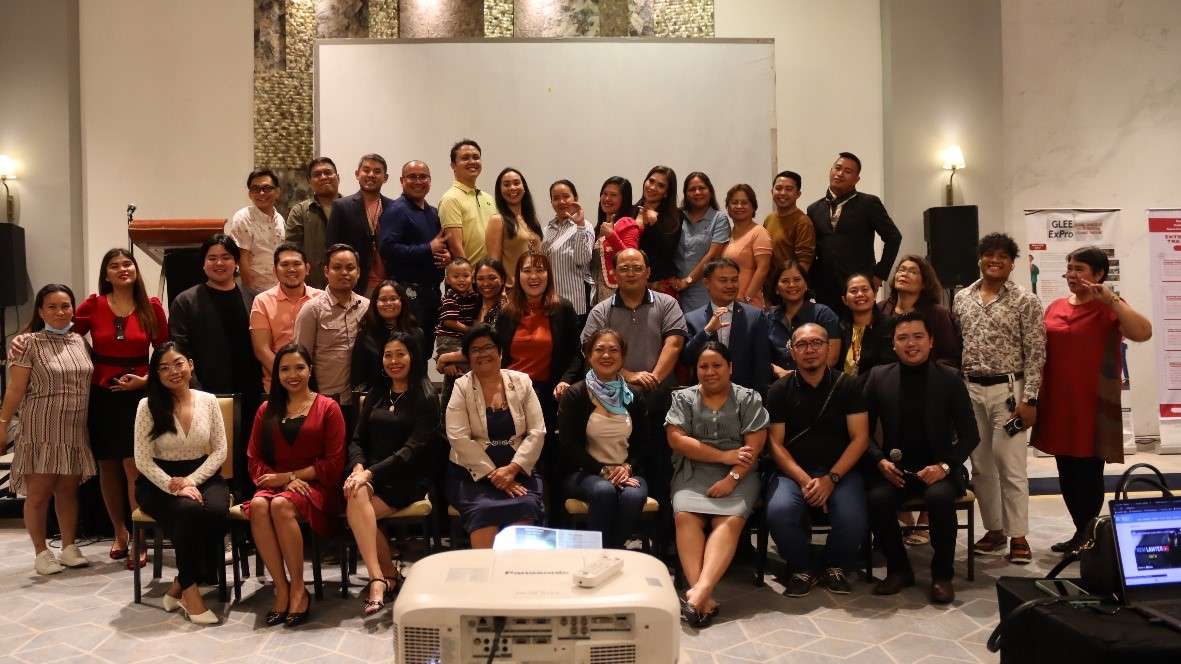
College of Arts and Sciences faculty members get ready with their Internationalization Project Proposals.
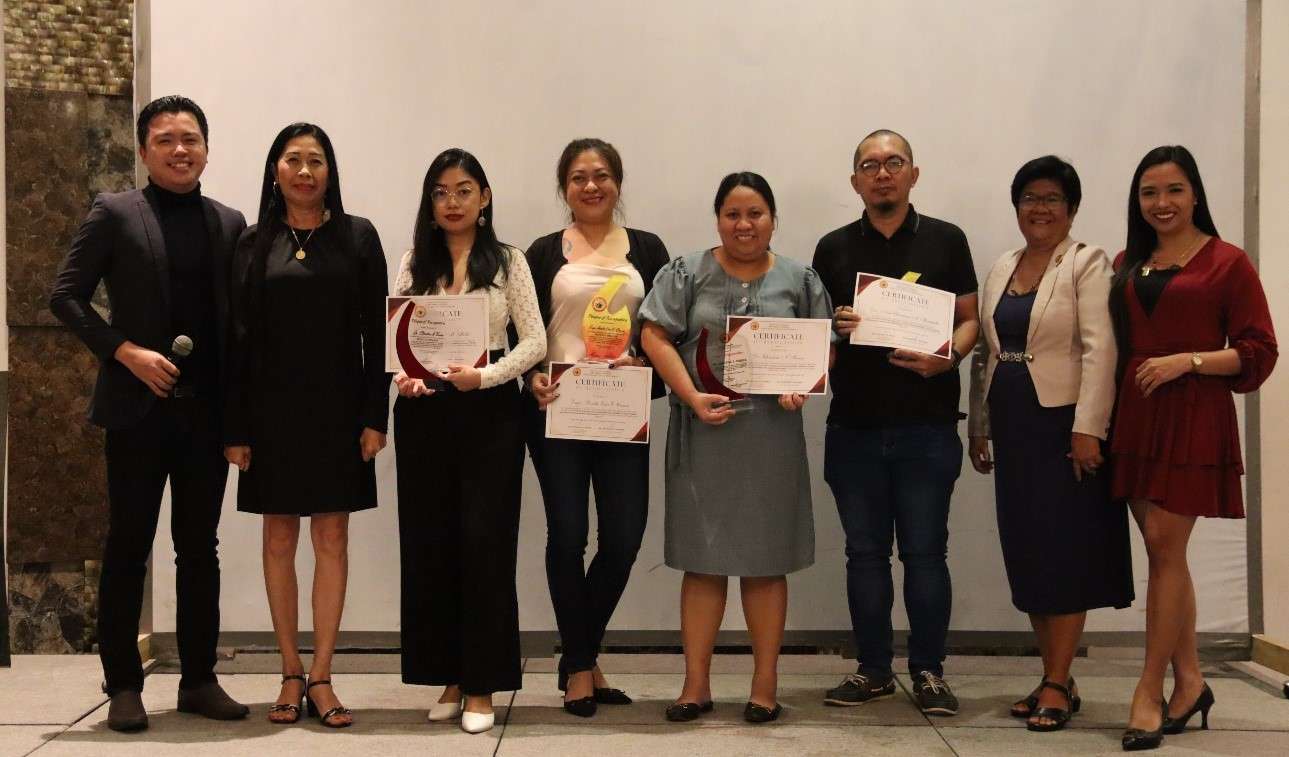
From left to right: Dr. Bustamante (Chair, International Relations), Dr. Greif (College Dean), Ms. Cachapero (Resource Speaker), Engr. Camus (Resource Speaker), Dr. Ferrer (Resource Speaker), Dr. Moratilla (Resource Speaker), Ms. Beltran (Director, Office of the External Affairs and International Linkages), Dr. Aharul (Chair, International Relations)

In the name of crimson and gold, various Departments and Research Institutes under College of Arts and Sciences (CAS) of Cebu Normal University held a three-day training and workshop called Internationalization Cascading and Training-Workshop held at Summit Galleria Hotel on April 12-14, 2023.
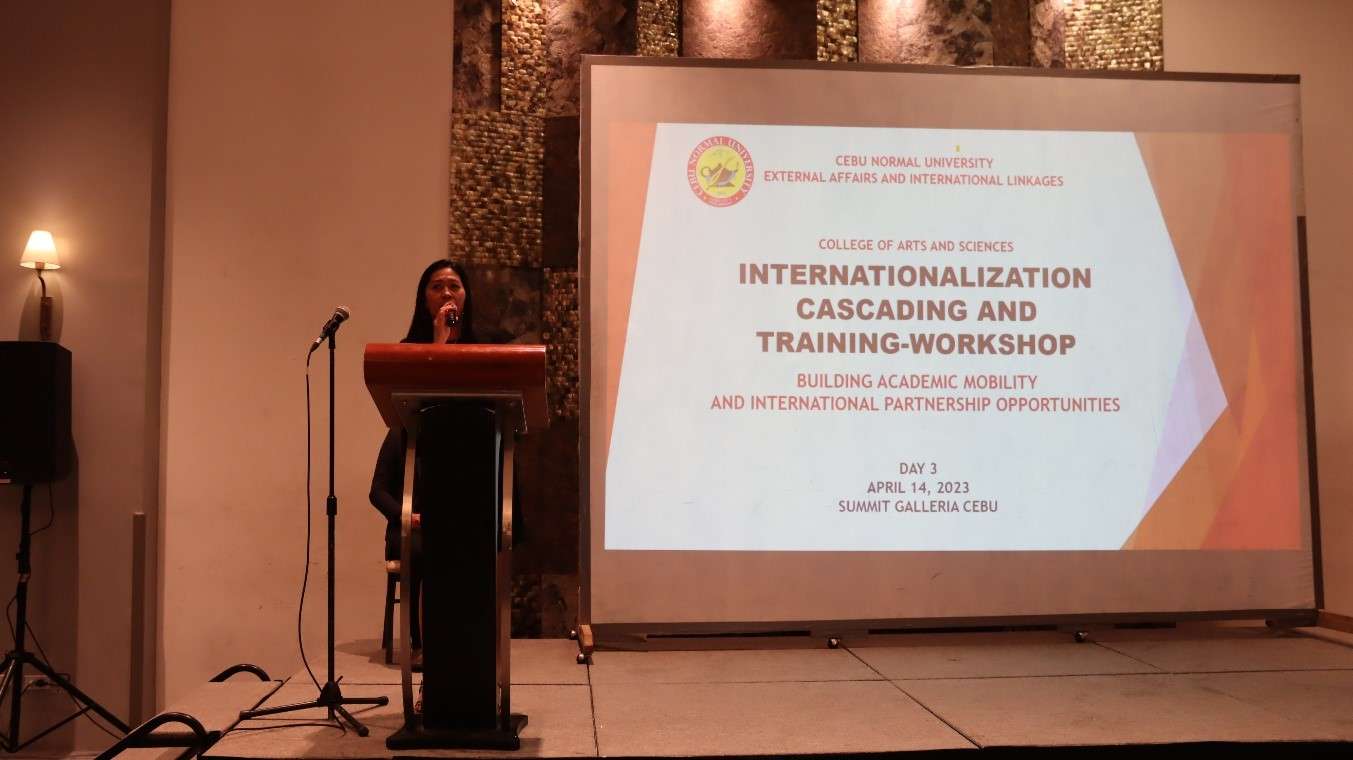
Dr.Milagros Greif, the College Dean, shared a message to the participants.

Bearing the theme “Building Academic Mobility and International Partnership Opportunities,” the goal of the said event was to bolster the university’s high-caliber education and services through solid collaboration and strategic planning for internationalization (IZN), such as proposing projects that will globalize students, increase cultural competence and diversity, broaden the research horizon of the university, and strengthen its institutional capacity.

“Understanding our purpose for internationalization, learning from our own practices and benchmarking from other institutions in this ever-changing higher education landscape, give us the motivation and determination to carry on what we have started. This might be challenging but doable,” said Dr. Angeline M. Pogoy, Vice President for Research, Extension and Publication.

Over the years, Cebu Normal University has been receiving awards and accolades with its national feats. Its ambitious aim now is to position itself outside the national borders, map out its direction toward international partners, and expand its linkages while fortifying its relationship with its existing partners.

“If our dreams are not lofty, they will remain a to-do list…our dream now is to aim higher,” said Dr. Michelle Mae J. Olvido, Presidential Assistant for Planning and Development Office.

In her speech, Dr. Olvido also emphasized the need for adapting strategic and sustainable ways of internationalizing the university while upholding social sensitivity and excellence. She also tackled how internationalization as a direction would change the university in different levels.

During the breakout sessions of the event, the three representatives from each department were given more than an hour to plan and craft their project proposal which would be presented on the last day. An open forum was also conducted to ask questions, offer suggestions, and share experiences.
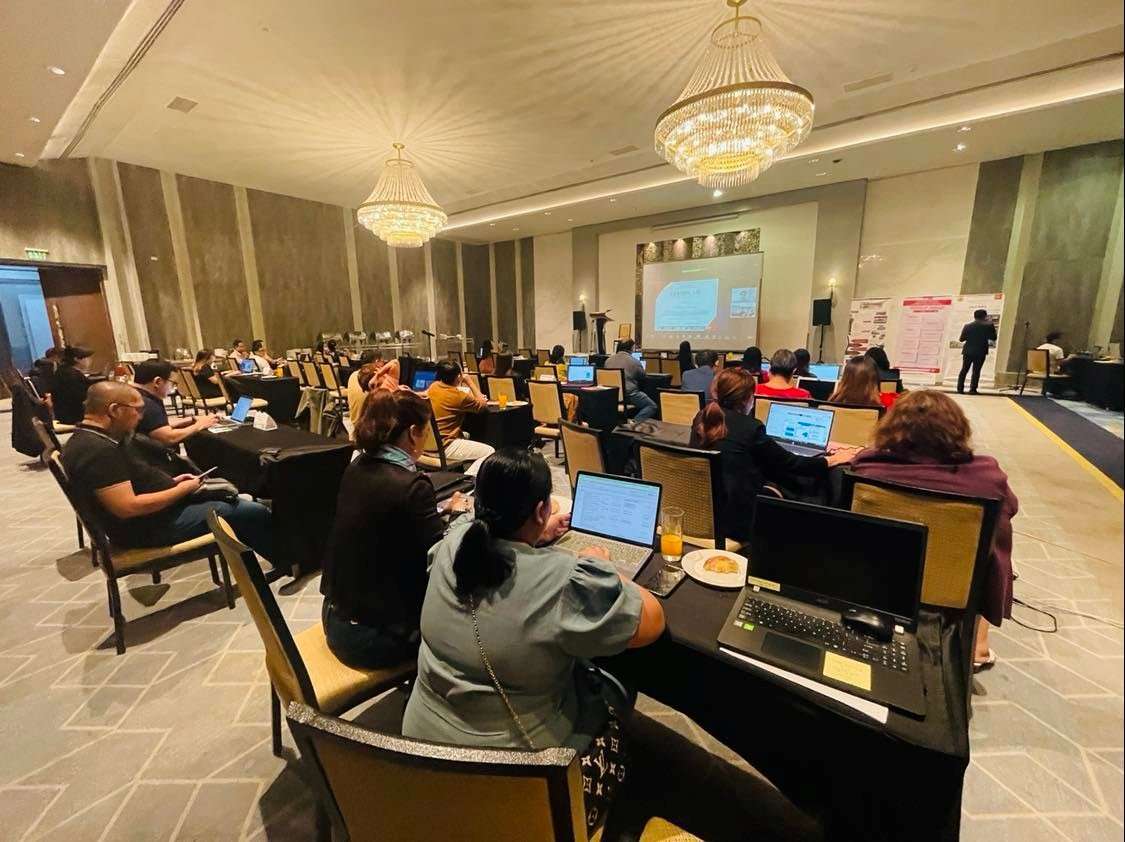
Participants crafting their internationalization project proposals during the breakout sessions.

CNU in the threshold of the global doors
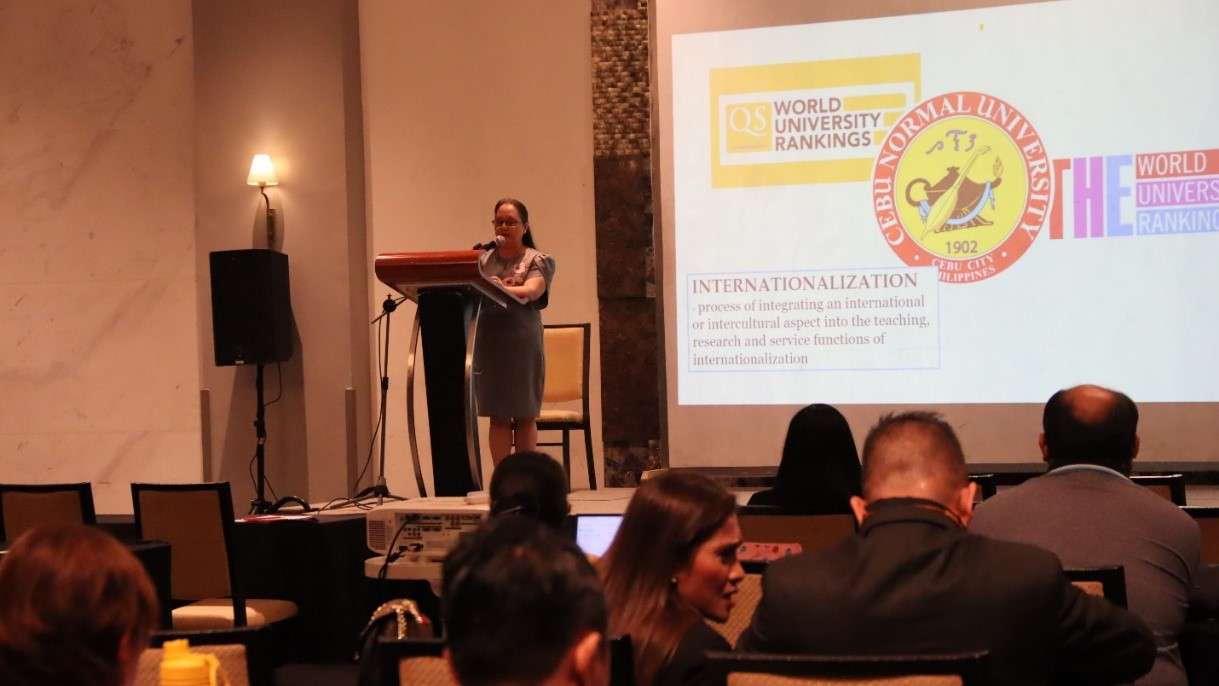
Dr. Daisy Palompon, former OIC-President, emphasized the CNU internationalization initiatives.

Cebu Normal University, being a leading multidisciplinary research university, was recently rated an overall three stars by Quacquarelli Symonds (QS), a global leading provider of services, analytics, and insights to higher education institutions in the world. The international badge it acquired is one of the significant leaps in strengthening its international profile, not to mention that QS gave a 5-star rating for its inclusivity while 4 stars for academic development, employability, and social responsibility.

On the other hand, CNU has already started putting its foot on the threshold of the global doors when it accepted and warmly welcomed a few international students to study in its undergraduate programs. Since internationalization is still uncharted waters, the university needs to be innovative and flexible, and must abide with the international policies without disregarding the essentiality of having its faculty members and stakeholders united in crafting and realizing globalized programs.

“You need to be united, you need to stand on the same ground, you need to be on the same boat,” said Engr. Rosette Eira Camus, one of the three guest speakers during the event and is the Director of International Career and Exchange Programs of Mapua University.

In her talk entitled “Internationalization Partnership Models and Framework,” Engr. Camus clearly sketched out a blueprint on how CNU can achieve internationalization successfully. Given its limited resources yet, she said that the university must build sustainable projects and assess its operational and financial fit to work with an international partner.
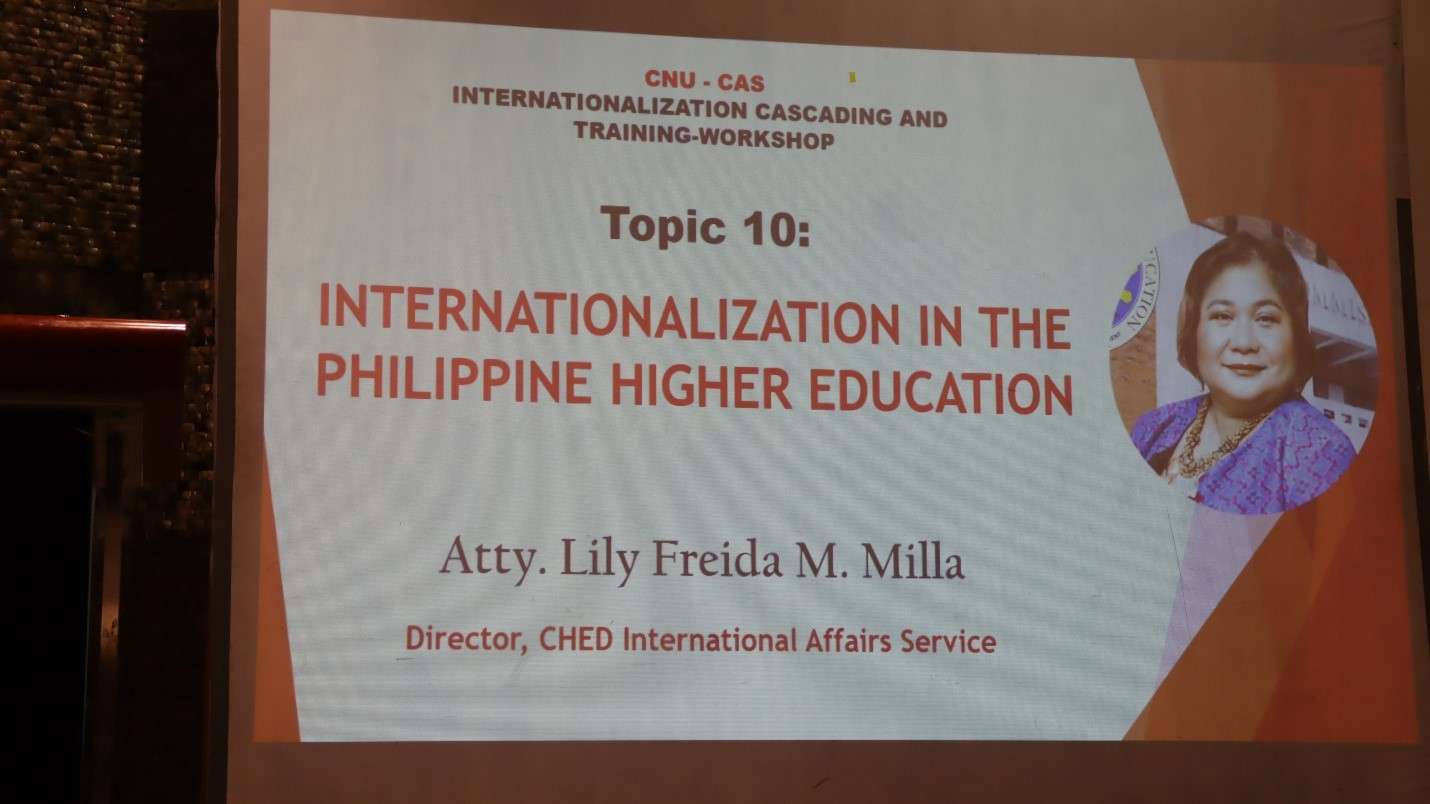
Atty. Lily Freida Milla, the Director of the Commission on Higher Education International Affairs Services (CHED-IAS), graced the event via Zoom with her inputs on what the CHED envisions the Philippine Higher Education Institutions to be in relation to building academic partnerships for quality education.

A few of the fundamental strategies CNU can adopt in expanding its reach are to build niche or flagship programs, acquire visiting professors, and join international conferences to increase the university’s input and output. Since the teaching models and methodologies play a key role in internationalizing an academic institution, CNU must also be fully abreast with technology as it will equip students with global experience, international skills, and intercultural competence without leaving the campus.

 Internationalization Projects

To increase the university’s global presence, CNU launched a program called Cross-Cultural Communication Virtual Exchange (CCCVEX), striking a vibrant partnership with Douglas College in New Westminster, British Columbia, Canada. The said program, which will start on August–December 2023, offers Collaborative Online International Learning (COIL), which is a competent platform for faculty members to facilitate students and enrich their intercultural competence through the use of technology.
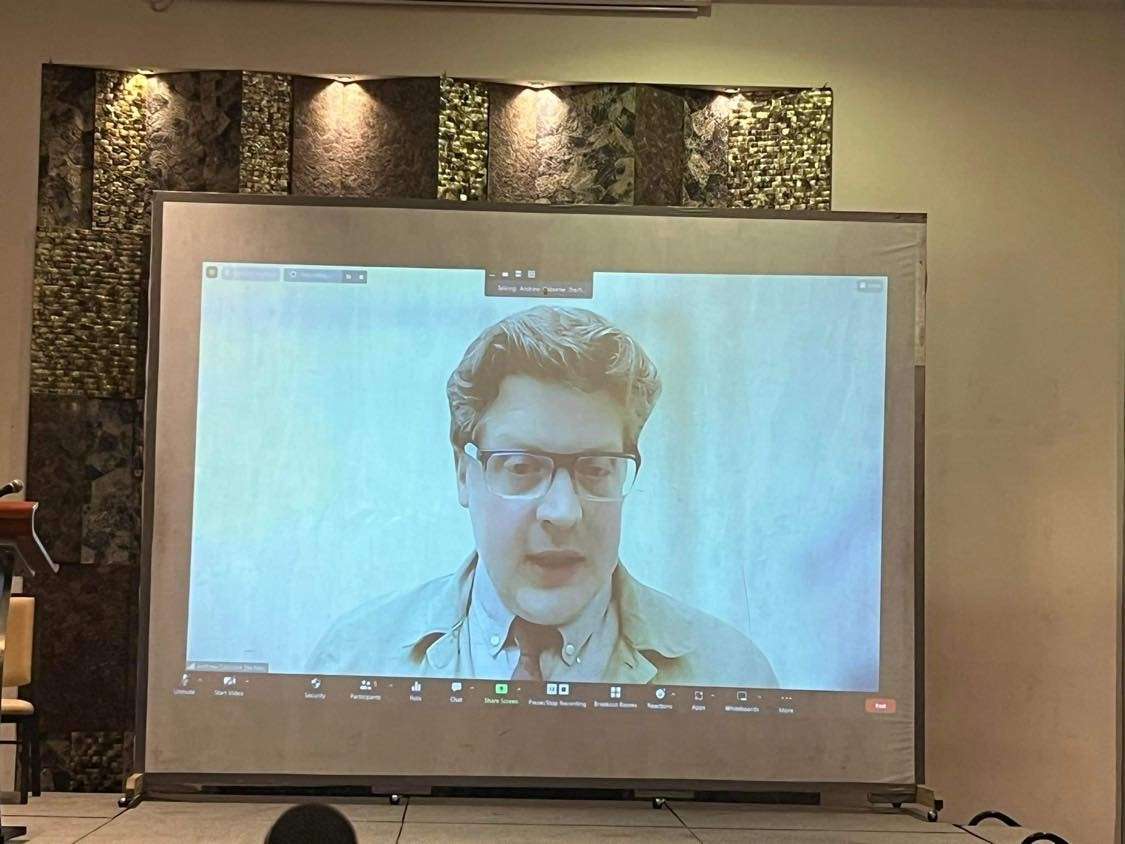
Prof. Andrew Osborne of Douglas College Canada presented via Zoom the Collaborative Online Interactive Learning (COIL) Project in collaboration with the CNU Department of Languages and Literature.

On the other hand, the Department of Languages and Literature is also proudly launching the English Intensive Training Program, which offers seven courses, with writing and speaking being the focus. The said program will aid international non-English-speaking students who are enrolled in the university to learn and improve their English communication skills. To further bolster competencies, the said department also has an international academic exchange program called Global Learners of English Education Exchange Program or GLEE ExPro to be offered at the undergraduate level for one semester, targeting international students coming from partner institutions.

Moreover, during the said training-workshop all the Departments—which are the Departments of Communication, Mathematics, Tourism,  English, Biology, Social Sciences, Public Governance, Chemistry and Physics, Filipino, Psychology, the three Research Institutes: Computational Mathematics and Physics; Public Governance; Tropical Biology and Pharmacological Biotechnology, and the Gender and Development Unit–successfully presented and justified their internationalization project proposals specific to their departmental needs and capacity, such as student and faculty exchange, and internship abroad.

Internationalization (IZN) Project Ways Forward

The internationalization project proposals of the different departments and institutes of the College of Arts and Sciences will undergo the next phase of evaluation which is the in-house review. With the next phase of evaluations and deliberations, it is targeted that the implementations of the projects commence the soonest as possible. The Office of the External Affairs and International Linkages through Director Naila Beltran, together with Dr. Milagros M. Greif the Dean of the College of Arts and Sciences will take the lead in realizing the ways forward of the internationalization project proposals.

Contact Office:
Dir. Naila Y. Beltran
External Affairs and International Linkages Office
international.linkages@cnu.edu.ph


X
Cebu Normal University
PRIVACY POLICY

Policy Statement

This Privacy Policy is adopted in compliance with the Data Privacy Act of 2012 (Republic Act No. 10173), its Implementing Rules and Regulations (IRR), and other relevant issuances of the National Privacy Commission (NPC). The University is committed to protecting and respecting your personal data privacy. We process personal information in accordance with the principles of transparency, legitimate purpose, and proportionality. This Policy informs how we collect, use, disclose, store, protect, and dispose personal information of our data subjects.

Definitions

Personal information refers to any information, whether recorded in a material form or not, from which the identity of an individual is apparent or can be reasonably and directly ascertained by the entity holding the information or when put together with other information that would directly and certainly identify an individual.

Sensitive information is a type of personal information with the risk of discrimination against the Data Subject. These are about an identifiable person’s racial or ethnic origin, marital status, color, and religious, philosophical, or political affiliations. It is also, about an individual’s health, education, the genetic or sexual life of person, or any proceeding for any offense committed or alleged to have been committed by such person, the disposal of such proceedings, or the sentence of any court in such proceedings; Issued by government agencies peculiar to an individual which includes, but not limited to, social security numbers, previous or current health records, licenses or its denials, suspension or revocation, and tax returns; and specifically established by an executive order or an act of Congress to be kept classified.

Privileged information refers to any and all forms of data which under the Rules of Court and other pertinent laws constitute privileged communication.

Information We Collect

The University may collect personal information in the context of its regular functions — including but not limited to the following categories:

  1. Students: contact and enrollment details, academic records, health or medical records, accommodation records, student-activity participation, and related data.
  2. Staff and job applicants: contact details, employment history, qualifications, employee-related data.
  3. Alumni profiling: contact and demographic details.
  4. Visitors, volunteers, and other stakeholders: information collected through sign-in forms, CCTV or security monitoring, photos or recordings during official events, surveys, and feedback forms.

Collection may occur by any medium, including: paper forms, electronic forms, email, website or online platforms, CCTV or video/photographic capture, surveys/questionnaires, and other lawful means.

Purposes and Uses of the Data Collected and Processed

Personal information collected may be used for:

  1. Administration of admission, enrollment, employment, alumni relations, and other official functions.
  2. Maintenance of student and employee records, including academic, health, and administrative data.
  3. Provision of University services such as counseling, scholarship administration, placement, library access, facilities use, laboratory access, security, parking, and accommodation.
  4. Internal research, quality assurance, performance monitoring, and institutional planning.
  5. Compliance with statutory obligations (e.g. reporting to government agencies when required).
  6. Security, safety, and campus management, including CCTV monitoring.

Legal Basis / Lawful Criteria for Processing

All processing of personal data is carried out in accordance with the legality, fairness, and lawfulness requirements under the Data Privacy Act and IRR.
Where applicable, processing is grounded on consent, contract, legal obligation, legitimate interest, or other lawful bases recognized under the law. The choice of lawful basis depends on the nature of data, the purpose of processing, and legal or contractual requirements.

Manner of Collection and Processing

Personal data may be collected through physical forms (paper-based), electronic forms, online or web-based platforms (e.g., registration portals, email, institutional website), CCTV or video/photo capture (for security or surveillance), event sign-in sheets or registration forms, surveys or questionnaires, or other legitimate and lawful means.

Processing may include collection, recording, sorting, storing, retrieval, use, updating, modification, blocking, destruction or other operations as allowed under the law, consistent with declared purposes.

Disclosure of Information

The University does not disclose personal information except under the following circumstances:

  1. Internal disclosure within authorized University personnel, only when necessary and appropriate for legitimate institutional purposes.
  2. External disclosure only when required or permitted by law (e.g. statutory obligations), or when the data subject has provided valid consent.
  3. Sensitive personal information or privileged information is processed and disclosed only in accordance with relevant legal provisions.

Risks, Safeguards and Security Measures

The University recognizes that processing of personal data entails certain privacy and security risks. Accordingly, we implement appropriate organizational, technical, and physical security safeguards to protect the confidentiality, integrity, and availability of personal data — whether in electronic or physical form. Such measures include (but are not limited to):

  1. Access controls (both digital and physical) to restrict access only to authorized personnel
  2. Use of secure storage: locked filing cabinets or secure rooms for physical records; password-protected systems, encryption, secure servers, firewalls for electronic data
  3. Secure transmission of data (when shared or transferred), secure printing and disposal protocols, and safe deletion or destruction of data when no longer needed
  4. Classification of data and periodic review of security protocols, to ensure adequacy in light of the risks presented and sensitivity of the data processed

Rights of Data Subjects

Under the Data Privacy Act and its IRR, data subjects have the following rights:

  1. Right to be informed — you have the right to know whether personal information about you will be, is being, or has been processed; the purposes of processing; the personal data to be entered; and the scope and method of processing.
  2. Right to access, correct, or update your data — you may request access to your personal information, ask for rectification of inaccuracies, or request updates.
  3. Right to object or withdraw consent — when processing is based on consent or legitimate interest, you may withdraw consent or object, subject to legal limits.
  4. Right to data portability — where applicable, you may obtain a copy of your personal data in a secure and portable format for transfer to another controller.
  5. Right to erasure or blocking — if personal data is incomplete, outdated, unlawfully obtained or processed, no longer necessary, or processing is unauthorized, you may request erasure or blocking, subject to legitimate grounds for retention (e.g. legal obligations or defense of legal claims).
  6. Right to damages — you may seek indemnification for damages resulting from inaccurate, incomplete, outdated, unlawfully obtained or unauthorized use of your personal data.
  7. Right to lodge a complaint with the NPC if you believe your data privacy rights have been violated.

Requests for access, rectification, objection, portability, erasure or complaints may be submitted in writing to the University’s designated Data Protection Officer (DPO) or Data Privacy Office.

Security, Retention, and Disposal

The University implements appropriate organizational, technical, and physical security measures to safeguard personal data — whether in paper or electronic form — against unauthorized access, disclosure, alteration, or destruction. Such measures include: secure storage (locked filing cabinets or rooms), restricted access to authorized personnel only, use of locked screens/screensavers, secure transmission (sealed envelopes or secure electronic transmission), secure printing and disposal of documents, and safe deletion or destruction of data when no longer needed.

Personal data will be retained only for as long as necessary to fulfill the declared and legitimate purposes, or as required for legal obligations or defense of legal claims. When no longer needed, personal data will be disposed of securely in accordance with University policy and relevant data-protection guidelines.

Consent, Notice, and Legitimate Processing

Where required by law, consent will be obtained from data subjects prior to collection or processing of their personal or sensitive data. In other cases (e.g. CCTV monitoring, legitimate interest), the University will inform data subjects through appropriate notice mechanisms before or at the time of data collection. Privacy notice(s) will accompany data-collection forms or be posted in conspicuous campus areas, and on the University website. At all times, data processing is based on legitimate purpose and proportional to the need.

Data Subject Access and Contact

To exercise your rights or if you have any inquiry, concern, or request regarding your personal data, please contact:

Omar B. Roma

Data Protection Officer
Email: dpo@cnu.edu.ph
Phone: 09422041421

Changes to This Policy

The University reserves the right to update or amend this Privacy Policy as necessary to reflect changes in applicable laws, regulations, regulatory guidance, or its internal data-processing practices. Updated versions will be posted on the University’s official website and, where appropriate, communicated to data subjects.