Cebu Normal University
THE OFFICE FOR INTERNATIONALIZATION & GLOBAL CITIZENSHIP

HEdConnect Session 2 reflects on pandemic and society

Multiple ideas ranging from societal, psychological, and cultural dimensions in connection to Coronavirus Disease 2019 (COVID-19) pandemic were highlighted during the conduct of Cebu Normal University (CNU)’s Higher Education Connect (HEdConnect) Session 2.

Read related article: [HEdConnect gathers education leaders to discuss the ‘new normal’ in higher ed]

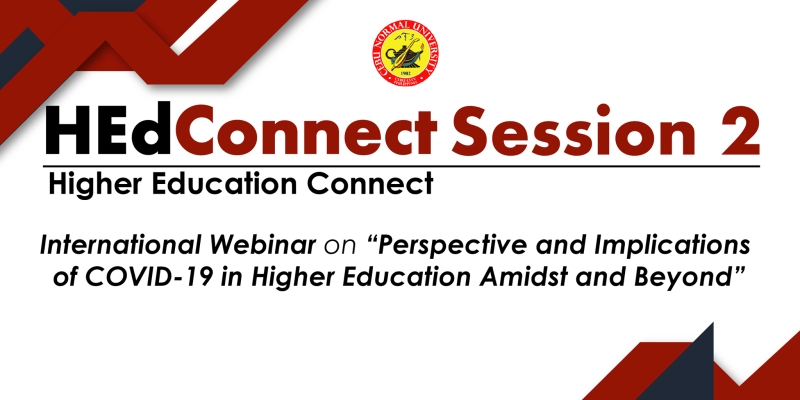
The discussion of the said international webinar dwelt on the Perspective and Implications of COVID-19 in Higher Education Amidst and Beyond. It was held via Zoom last August 14.

The HEdConnect Session 2 was organized by the College of Arts and Sciences (CAS) Social Science Department (SSD).

CNU Vice President for Academic Affairs, Dr. Daisy Palompon, said the HEdConnect version 2.0 is a sharing of great minds in addressing social, psychological, and cultural implications of COVID-19 in a multi-sectoral perspective. 

Four speakers graced the webinar including Dr. Nicole Curato, University of Canberra, Australia Center for Deliberative Democracy and Global Governance Associate Professor; Prof. Randy Pederi, CNU SSD Former Chairperson and current faculty; Dr. Emmanuel Hernani, CNU SSD faculty and CNU Ethics Review Board Chairperson; and Dr. Reynaldo Inocian, CNU SSD faculty and Culture, Arts, and Design Association of the Philippines (CADA-PHI), Inc. Founding President. 

Curato shared about Sociological Perspective and Implications of COVID-19; Pederi on Understanding COVID-19 through the Theory of Suicide: A Social Implication; Hernani on Psychological Perspective and Implications of COVID-19, and Inocian on Cultural Perspective and Implications of COVID-19.

Curato argued that the experience of the new normal depends on who we ask. She also argued if the new normal is indeed new.

She conveyed that the new normal is still under construction and expressed that people should refuse to accept the concept of normal as given.

“When someone says this is typical, we have to be skeptical. We have to ask questions. Who says it’s normal? Who benefits from what’s normal? And who is disadvantaged when we talk about this kind of normal?” Curato said.

“We can think or construct the normal as a time of creativity. The new normal can be a time of solidarity. It can be a time for innovation…I think we can do better if we start thinking about the pandemic from the perspective of the most vulnerable sectors of society,” she said.

“We know what the new normal is now, but we can still make a case for what the new normal should be,” she added.  

Pederi shared his studies on suicide and Emile Durkheim and related it to the situations brought by COVID-19. 

He said that COVID-19 is controlling the tempo of our current situation and many people now encounter the same psychological or emotional conditions with that of the suicide-lost loved ones.

“COVID-19 is no longer a health issue, not even a psychological or mental issue alone. It triggers the whole social system,” he said. 

Pederi said that for him, psychological considerations – emotional, social, mental, spiritual health – must be in place to address COVID-19. 

He said that the COVID-19 pandemic sparks all Filipinos to be reactive and this could be a manifestation of psychological or emotional distress or simply the issue of egoism and altruism or normlessness or anomie and fatalism. 

Hernani talked on mental health amid the pandemic and as a psychologist, he said that he is a proponent of gestalt therapy wherein he would always emphasize holistic, integrated, multifaceted components of dealing with some situations.

He emphasized that people should make use of their resources at home, environment, and community as an asset in coping. 

He also recommends each person to focus on one’s self or being in relation to his or her family, society, school, workplace, and the community to stay grounded as a person.

“In a form of reflection, try to look at it squarely…the positive and the negative side,” he said.

He concluded his discussion by saying that people should look at COVID-19 pandemic from two sides – the crisis, and the opportunities. 

Inocian focused his sharing on culture and cited different studies on how the Filipino culture has developed or evolved through time.

He said that amid this pandemic, culture is always there. 

“It can never be forgotten, so in every aspect of our life at home, while we are experiencing the lockdown, culture will always be part of that experience,” he said

He also shared two perspectives of culture which are the essentialist and progressivist perspectives and said that in practice it will always be a dialectical process in constant dialogue.

He also shared a study that compares how Filipino culture evolved through time and how people weigh its significance.

He also shared a study that ranks existence across different generations and also divulged how the culture of “bayanihan” and “panambal” or healing is relevant in this time of the pandemic.

“Truly, there are many thinkers, philosophers, teachers, experts among us, but let us not forget that after the rigor of accumulation of knowing, follows the mission to challenge and tackle down conditions and stature which are detrimental to human growth and development. After all, our aim to learn is not to simply interpret the world but to change it,” Prof. Jose Fermin Crave, CNU SSD Faculty said as part of his message.

Prof. Mervin Reyes, CNU SSD Chairperson moderated the webinar. A full copy of HEdConnect Session 2 can be viewed at the official YouTube account of the University. (JDF)

Cebu Normal University
PRIVACY POLICY

Policy Statement

This Privacy Policy is adopted in compliance with the Data Privacy Act of 2012 (Republic Act No. 10173), its Implementing Rules and Regulations (IRR), and other relevant issuances of the National Privacy Commission (NPC). The University is committed to protecting and respecting your personal data privacy. We process personal information in accordance with the principles of transparency, legitimate purpose, and proportionality. This Policy informs how we collect, use, disclose, store, protect, and dispose personal information of our data subjects.

Definitions

Personal information refers to any information, whether recorded in a material form or not, from which the identity of an individual is apparent or can be reasonably and directly ascertained by the entity holding the information or when put together with other information that would directly and certainly identify an individual.

Sensitive information is a type of personal information with the risk of discrimination against the Data Subject. These are about an identifiable person’s racial or ethnic origin, marital status, color, and religious, philosophical, or political affiliations. It is also, about an individual’s health, education, the genetic or sexual life of person, or any proceeding for any offense committed or alleged to have been committed by such person, the disposal of such proceedings, or the sentence of any court in such proceedings; Issued by government agencies peculiar to an individual which includes, but not limited to, social security numbers, previous or current health records, licenses or its denials, suspension or revocation, and tax returns; and specifically established by an executive order or an act of Congress to be kept classified.

Privileged information refers to any and all forms of data which under the Rules of Court and other pertinent laws constitute privileged communication.

Information We Collect

The University may collect personal information in the context of its regular functions — including but not limited to the following categories:

  1. Students: contact and enrollment details, academic records, health or medical records, accommodation records, student-activity participation, and related data.
  2. Staff and job applicants: contact details, employment history, qualifications, employee-related data.
  3. Alumni profiling: contact and demographic details.
  4. Visitors, volunteers, and other stakeholders: information collected through sign-in forms, CCTV or security monitoring, photos or recordings during official events, surveys, and feedback forms.

Collection may occur by any medium, including: paper forms, electronic forms, email, website or online platforms, CCTV or video/photographic capture, surveys/questionnaires, and other lawful means.

Purposes and Uses of the Data Collected and Processed

Personal information collected may be used for:

  1. Administration of admission, enrollment, employment, alumni relations, and other official functions.
  2. Maintenance of student and employee records, including academic, health, and administrative data.
  3. Provision of University services such as counseling, scholarship administration, placement, library access, facilities use, laboratory access, security, parking, and accommodation.
  4. Internal research, quality assurance, performance monitoring, and institutional planning.
  5. Compliance with statutory obligations (e.g. reporting to government agencies when required).
  6. Security, safety, and campus management, including CCTV monitoring.

Legal Basis / Lawful Criteria for Processing

All processing of personal data is carried out in accordance with the legality, fairness, and lawfulness requirements under the Data Privacy Act and IRR.
Where applicable, processing is grounded on consent, contract, legal obligation, legitimate interest, or other lawful bases recognized under the law. The choice of lawful basis depends on the nature of data, the purpose of processing, and legal or contractual requirements.

Manner of Collection and Processing

Personal data may be collected through physical forms (paper-based), electronic forms, online or web-based platforms (e.g., registration portals, email, institutional website), CCTV or video/photo capture (for security or surveillance), event sign-in sheets or registration forms, surveys or questionnaires, or other legitimate and lawful means.

Processing may include collection, recording, sorting, storing, retrieval, use, updating, modification, blocking, destruction or other operations as allowed under the law, consistent with declared purposes.

Disclosure of Information

The University does not disclose personal information except under the following circumstances:

  1. Internal disclosure within authorized University personnel, only when necessary and appropriate for legitimate institutional purposes.
  2. External disclosure only when required or permitted by law (e.g. statutory obligations), or when the data subject has provided valid consent.
  3. Sensitive personal information or privileged information is processed and disclosed only in accordance with relevant legal provisions.

Risks, Safeguards and Security Measures

The University recognizes that processing of personal data entails certain privacy and security risks. Accordingly, we implement appropriate organizational, technical, and physical security safeguards to protect the confidentiality, integrity, and availability of personal data — whether in electronic or physical form. Such measures include (but are not limited to):

  1. Access controls (both digital and physical) to restrict access only to authorized personnel
  2. Use of secure storage: locked filing cabinets or secure rooms for physical records; password-protected systems, encryption, secure servers, firewalls for electronic data
  3. Secure transmission of data (when shared or transferred), secure printing and disposal protocols, and safe deletion or destruction of data when no longer needed
  4. Classification of data and periodic review of security protocols, to ensure adequacy in light of the risks presented and sensitivity of the data processed

Rights of Data Subjects

Under the Data Privacy Act and its IRR, data subjects have the following rights:

  1. Right to be informed — you have the right to know whether personal information about you will be, is being, or has been processed; the purposes of processing; the personal data to be entered; and the scope and method of processing.
  2. Right to access, correct, or update your data — you may request access to your personal information, ask for rectification of inaccuracies, or request updates.
  3. Right to object or withdraw consent — when processing is based on consent or legitimate interest, you may withdraw consent or object, subject to legal limits.
  4. Right to data portability — where applicable, you may obtain a copy of your personal data in a secure and portable format for transfer to another controller.
  5. Right to erasure or blocking — if personal data is incomplete, outdated, unlawfully obtained or processed, no longer necessary, or processing is unauthorized, you may request erasure or blocking, subject to legitimate grounds for retention (e.g. legal obligations or defense of legal claims).
  6. Right to damages — you may seek indemnification for damages resulting from inaccurate, incomplete, outdated, unlawfully obtained or unauthorized use of your personal data.
  7. Right to lodge a complaint with the NPC if you believe your data privacy rights have been violated.

Requests for access, rectification, objection, portability, erasure or complaints may be submitted in writing to the University’s designated Data Protection Officer (DPO) or Data Privacy Office.

Security, Retention, and Disposal

The University implements appropriate organizational, technical, and physical security measures to safeguard personal data — whether in paper or electronic form — against unauthorized access, disclosure, alteration, or destruction. Such measures include: secure storage (locked filing cabinets or rooms), restricted access to authorized personnel only, use of locked screens/screensavers, secure transmission (sealed envelopes or secure electronic transmission), secure printing and disposal of documents, and safe deletion or destruction of data when no longer needed.

Personal data will be retained only for as long as necessary to fulfill the declared and legitimate purposes, or as required for legal obligations or defense of legal claims. When no longer needed, personal data will be disposed of securely in accordance with University policy and relevant data-protection guidelines.

Consent, Notice, and Legitimate Processing

Where required by law, consent will be obtained from data subjects prior to collection or processing of their personal or sensitive data. In other cases (e.g. CCTV monitoring, legitimate interest), the University will inform data subjects through appropriate notice mechanisms before or at the time of data collection. Privacy notice(s) will accompany data-collection forms or be posted in conspicuous campus areas, and on the University website. At all times, data processing is based on legitimate purpose and proportional to the need.

Data Subject Access and Contact

To exercise your rights or if you have any inquiry, concern, or request regarding your personal data, please contact:

Omar B. Roma

Data Protection Officer
Email: dpo@cnu.edu.ph
Phone: 09422041421

Changes to This Policy

The University reserves the right to update or amend this Privacy Policy as necessary to reflect changes in applicable laws, regulations, regulatory guidance, or its internal data-processing practices. Updated versions will be posted on the University’s official website and, where appropriate, communicated to data subjects.