To strengthen the use of mathematical and computational approaches in understanding and predicting infectious disease dynamics,
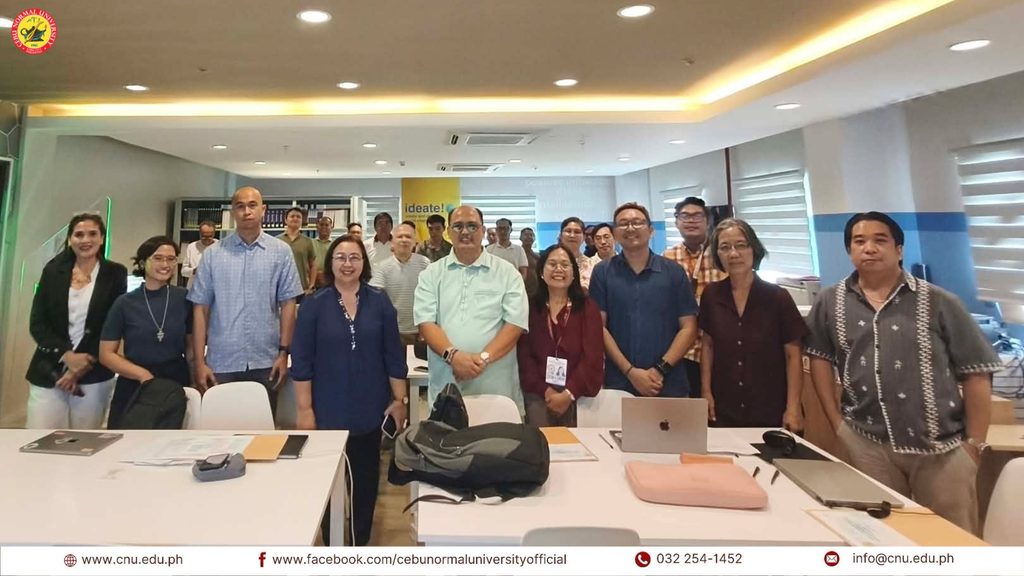
Cebu Normal University (CNU) research institute directors and select faculty members were apprised on mathematical modelling of infectious disease dynamics.
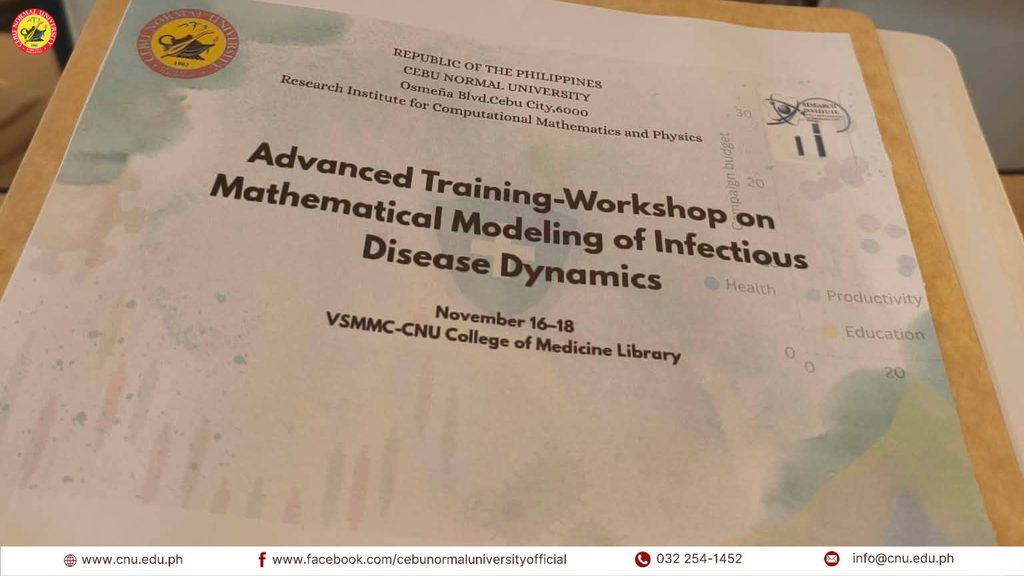
Held at the Vicente Sotto Memorial Medical Center (VSMMC)-College of Medicine (COM) on November 16–18, the Research Institute for Computational Mathematics and Physics (RICMP)-led training focused on developing mathematical models to better understand disease transmission patterns, forecast possible outbreaks, and inform timely and evidence-based public health interventions.
The sessions were led by VSMMC-COM Dean Dr. Jarungchai Sato Vatanagul and featured Dr. Jomar F. Rabajante, a professor at the University of the Philippines Los Baños (UPLB).
Dr. Rabajante, who spearheaded the UP COVID-19 Response Team responsible for providing daily COVID-19 case data and projecting possible infection peaks during the COVID-19 pandemic in the Philippines, shared his expertise and experiences in developing mathematical models to analyze infectious disease dynamics.
The workshop provided participants with comprehensive discussions and hands-on learning opportunities on various mathematical and computational approaches.
These included compartmental models such as Susceptible-Infectious-Recovered (SIR), Susceptible-Exposed-Infectious-Recovered (SEIR), and their suitable extensions; age-structured, spatial, network-based, and stochastic epidemic models; optimal control and the evaluation of intervention strategies; parameter estimation, model calibration, time-series analysis, and forecasting; and the modelling of emerging and re-emerging infectious diseases, including climate-sensitive disease dynamics.
Moreover, CNU College of Sciences faculty members Russel Christine Corcino and Dr. Dominic Franco Belleza introduced participants to R programming, a computational tool used in solving systems of differential equations that mathematically represent infectious disease models.
The sessions also demonstrated its applications in processing, cleaning, and preparing raw epidemiological data for analysis.
The training further highlighted uncertainty quantification, sensitivity analysis, and comparative model evaluation, emphasizing the integration of mathematical theory, programming, and data analytics in epidemiological research.
For her part, Vice President for Research and Extension Services Dr. Angeline Pogoy emphasized the importance of systematic and timely responses to public health concerns through the application of mathematics.
“We have learned from the recent public health experiences that responding to disease outbreaks requires more than immediate medical interventions,” she said.
“It also requires the ability to understand patterns of transmission, analyze available data, estimate possible risks, and anticipate how diseases may develop and spread. Mathematical modelling provides us with powerful tools to do these things,” she added.
Led by RICMP Director Dr. Roberto Corcino, the training reinforces the university’s commitment to advancing interdisciplinary research and strengthening scientific capacity through the integration of mathematics, computational science, and public health.
Through initiatives such as this, CNU continues to promote research-driven solutions to emerging societal challenges, equipping researchers and faculty members with the knowledge and technical skills necessary to contribute to disease surveillance, outbreak preparedness, and evidence-based decision-making in public health.
Padayon, CNU!
#AlwaysCrimsonAndGold2026
#SDG4QualityEducation
#sdg17PartnershipsForTheGoals