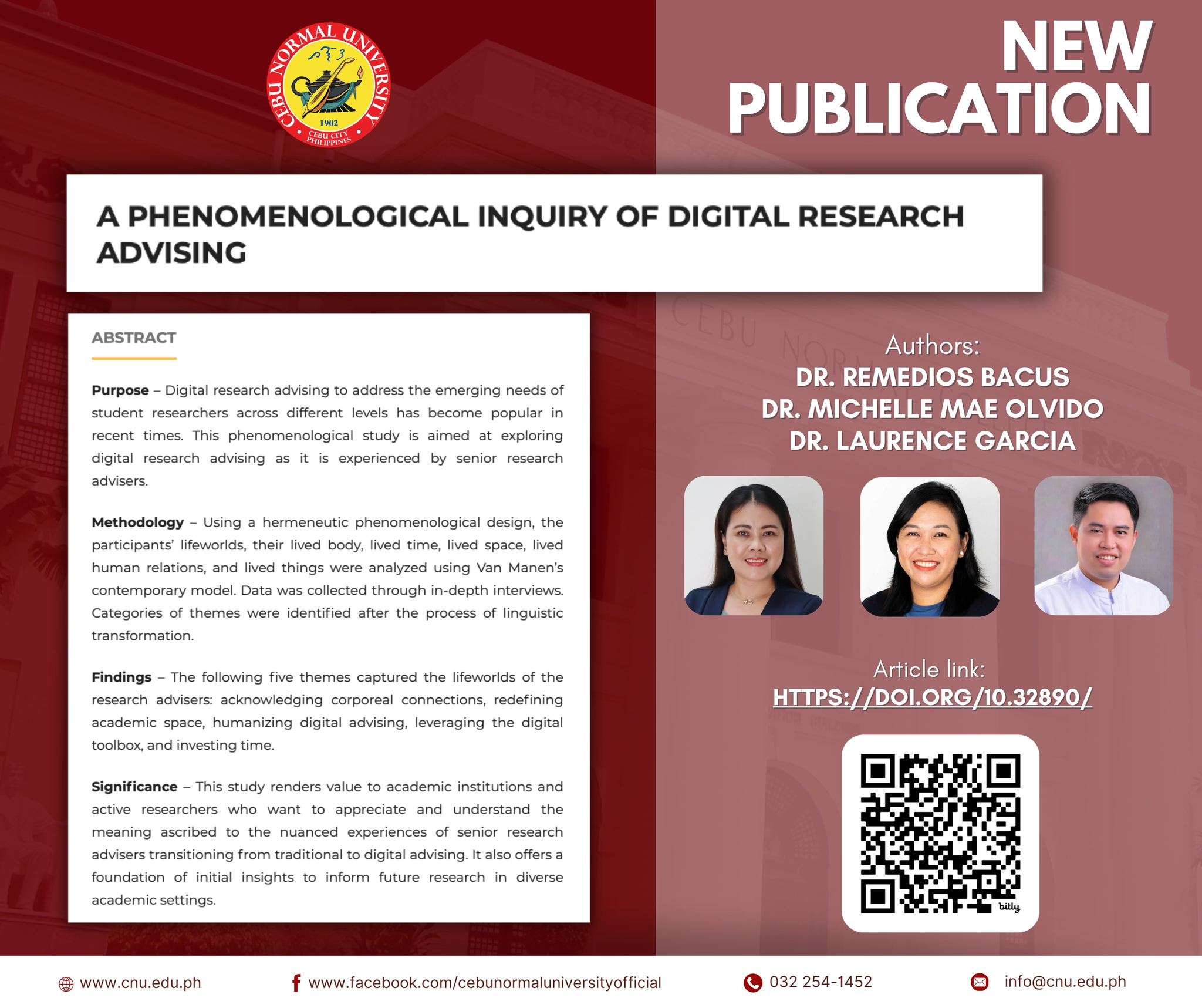
Three researchers from Cebu Normal University have published a new study examining the evolving practice of digital research advising, offering timely insights into how academic mentorship is adapting to the changing needs of student researchers across educational levels.
The paper, authored by Dr. Remedios Cabaral Bacus, Dr. Michelle Mae Olvido, and Dr. Laurence Garcia, was published on January 31, 2026 in the Malaysian Journal of Learning and Instruction (MJLI)—a journal indexed in both Scopus and Web of Science (Clarivate Analytics). The publication marks a significant scholarly contribution from the university to the global research community.
Dr. Bacus and Dr. Olvido are both faculty members of the College of Teacher Education, while Dr. Garcia, the new president of CNU, is a faculty member of the College of Nursing, Allied Health and Sciences.
Using a phenomenological research design, the study explores digital research advising as experienced by senior research advisers, focusing on their transition from traditional, face-to-face advising to digitally mediated approaches. As universities increasingly rely on online platforms for supervision and mentorship, the study addresses a growing gap in understanding how advisers themselves make sense of this shift.
According to the authors, the purpose of the study is to 𝙚𝙭𝙖𝙢𝙞𝙣𝙚 𝙝𝙤𝙬 𝙙𝙞𝙜𝙞𝙩𝙖𝙡 𝙧𝙚𝙨𝙚𝙖𝙧𝙘𝙝 𝙖𝙙𝙫𝙞𝙨𝙞𝙣𝙜 𝙧𝙚𝙨𝙥𝙤𝙣𝙙𝙨 𝙩𝙤 𝙩𝙝𝙚 𝙚𝙢𝙚𝙧𝙜𝙞𝙣𝙜 𝙖𝙣𝙙 𝙙𝙞𝙫𝙚𝙧𝙨𝙚 𝙣𝙚𝙚𝙙𝙨 𝙤𝙛 𝙨𝙩𝙪𝙙𝙚𝙣𝙩 𝙧𝙚𝙨𝙚𝙖𝙧𝙘𝙝𝙚𝙧𝙨—from undergraduate to advanced graduate levels. By foregrounding the lived experiences of seasoned advisers, the research highlights both the opportunities and complexities introduced by digital environments.
The study’s significance lies in its relevance to academic institutions, faculty members, and active researchers seeking to better understand the human and pedagogical dimensions of digital advising.
“This study renders value to academic institutions and active researchers who want to appreciate and understand the meaning ascribed to the nuanced experiences of senior research advisers transitioning from traditional to digital advising,” the paper’s abstract read.
Beyond its immediate findings, the research also serves as a foundational reference for future studies on digital research advising, particularly in diverse academic and cultural contexts.
The publication underscores Cebu Norma University’s growing presence in internationally indexed research and contributes to ongoing global conversations about innovation, quality, and adaptability in higher education research practices.